
Football fitness training for 10 year olds: sharpen skills, add structure
A 10 year old footballer is ready for coached running mechanics, controlled landings, turning on both feet and short bodyweight routines. Most are still before the growth spurt, so the plan stays light and playful. Keep sessions varied, avoid heavy loading, and let technique and enjoyment lead any fitness work.
 Cibiraj Sathishkumar · Accredited Exercise and Sports Scientist, Founder of EvoQuest
Updated · 4 min read
Key takeaways
- At ten, children can follow cues, so running, stopping and landing can be coached directly.
- Small-sided games remain the best fitness tool and give most of the running a child needs.
- Add 10 minutes of bodyweight strength and balance work, not weights or long runs.
- Use both feet and both directions in every drill to build balanced movement.
- Plan rest weeks around exams and tournaments to protect enthusiasm and growing tissue.
On this page
What changes between 9 and 10
The biggest change is attention. A 10 year old can hold two coaching cues at once, such as "quiet feet" and "eyes up", which lets a coach teach how to sprint and stop instead of just playing. Reaction time and rhythm also improve, so ladder-style footwork becomes a game the child can actually do.
Growth is still steady for most boys and many girls, but some girls start their growth spurt around 10 or 11. The maturation review by Lundberg and colleagues covers how children of the same calendar age can differ markedly in biological maturity, so a coach should judge readiness by the child, not the birth certificate.
Class 5 in India often brings the first inter-school football matches, so game exposure rises faster than fitness preparation. That is the gap these sessions fill.
Running, stopping and landing skills
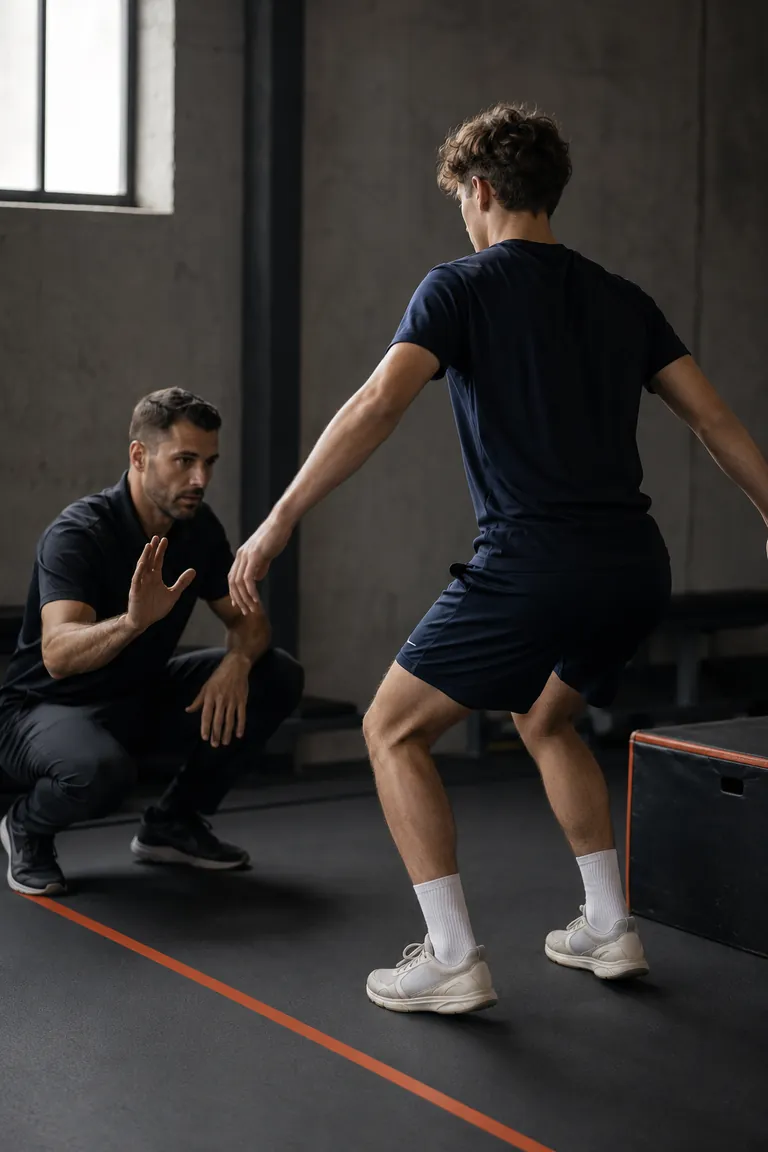
Teach three things in a session: how to accelerate with a forward lean, how to decelerate with the knees bent and chest over the feet, and how to land softly from small jumps. These match what a footballer does constantly in a match and carry across to every other sport.
Drills should be short. For example, five 10 metre runs ending in a balanced stop, three single-leg landings per side, and a figure-of-eight dribble that forces turns on both feet. Rest until the child is breathing normally again.
Neuromuscular training that mixes balance, jumping and landing has been linked to lower injury rates in youth athletes. The Steib dose-response meta-analysis suggests that regular programmes help, and that consistent, well-coached work matters more than any one exercise.
Parents can check progress without any equipment. Ask the child to hop on one leg and stick the landing for three seconds, then repeat on the other side. If one leg wobbles clearly more, note it and add a few extra balance holds on that side over the next month. Film a short clip on a phone every few weeks to compare, and share it with the coach instead of pushing the child to try harder.
A 10 minute strength and balance routine
Perform this twice in a week after a warm-up, in school PE time if possible. The NSCA guidance supports low-load, high-quality work for this age and says progression should follow technique.
What to avoid at 10
Avoid weekly time trials against the clock, which turn practice into a sorting exercise. Avoid letting a child play every match when two teams want them, and avoid drills that ask for hard kicking volume with a heavy ball.
Skip long static stretches before play. A systematic review found acute static stretch can slightly reduce muscle performance, so save it for after training and keep it light.
If your child complains of pain at the knee, heel or shin that returns every practice, stop the offending activity and see a doctor or physiotherapist. Do not diagnose it at home.
Sample week for a 10 year old
- Two football practices with small-sided games and a short skill block
- One match or tournament day, with water breaks every 15 to 20 minutes in heat
- One 10 minute strength and balance routine, added to a practice
- One non-football activity such as swimming, badminton or athletics
- Two rest days with free play only
During school exams, cut the extra routine and keep only play. A child who is sleeping badly or studying late recovers poorly from training.
What EvoQuest Sports Science can add
For families who want objective feedback, EvoQuest can look at how a young player jumps, lands and changes direction using force plates and timing gates, and explain the findings in plain language. The lab does not rank children against each other. A free 20-minute call will tell you whether a visit suits your child's age and goals.
Frequently asked questions
What fitness training is suitable for a 10 year old footballer?
Coached running and landing skills, small-sided games, balance work and short bodyweight routines suit this age. Keep volume low and variety high. Heavy lifting, long runs and repeated time trials are unnecessary and can reduce enjoyment.
Should a 10 year old play football every day?
Daily football, especially in heat, adds load without clear gain. Most guidance supports a mix of practice, matches, other sports and rest days. Signs the load is too high include persistent tiredness, pain, falling grades or loss of interest in playing.
Does a 10 year old need to stretch?
Gentle stretching after play is fine and many children enjoy it. Long static holds before play are not recommended because they may slightly reduce muscle performance. A jog, skips and leg swings followed by a ball game make a better warm-up.
Are girls and boys trained differently at 10?
Training content is similar at this age. The main difference is that some girls reach their growth spurt earlier, so coaches should watch for sudden clumsiness or knee strain and adjust load. Landing and balance work is useful for all children, and especially valuable for girls entering the growth years.
This article is general education. Train within your current ability and get coaching if you are unsure about technique.
References
- National Strength and Conditioning Association position statement on long-term athletic development (Lloyd et al., 2016) Journal of Strength and Conditioning Research
- Dose-response relationship of neuromuscular training for injury prevention in youth athletes: a meta-analysis Frontiers in Physiology, Steib et al., 2017
- Growth and maturation assessment in youth sport: balancing benefits and risks Scandinavian Journal of Medicine & Science in Sports, Lundberg et al., 2026
- Effect of acute static stretch on maximal muscle performance: a systematic review Medicine & Science in Sports & Exercise, Kay and Blazevich, 2012
Cibiraj studied Exercise and Sports Science at Deakin University in Australia and worked as a strength and conditioning coach for cricket and football clubs in Melbourne before founding EvoQuest in Coimbatore. He runs the performance assessments and writes every diagnostics report, so the person who measures you is the one who explains the numbers.