
Football fitness training for 11 year olds: skill first, fitness through play
Football fitness for an 11 year old should be built around the ball: small-sided games, quick feet, short sprints with full rest, jumping and landing practice and simple bodyweight strength. Most children are still before their growth spurt, so the goal is coordination and enjoyment, not heavy loads or long running.
 Cibiraj Sathishkumar · Accredited Exercise and Sports Scientist, Founder of EvoQuest
Updated · 4 min read
Key takeaways
- At 11 most children are before the growth spurt, so coordination gains come easily.
- Small-sided games give more touches and sprints than long drills.
- Bodyweight strength and landing skills are enough resistance work at this age.
- Avoid long distance running and playing the same position all year.
- EvoQuest can run a youth assessment from age 9 to give a child a personal baseline.
On this page
Where an 11 year old is in growth
Most 11 year olds are in the pre-peak-height-velocity stage, the years before the big growth spurt. Girls often reach the spurt earlier than boys, so some may already be changing. The NSCA long-term athletic development statement treats this stage as a window for learning movement skills, with fitness following from play.
Children of the same age can differ by two or more years in biological development. A tall, early-maturing 11 year old may look like a 13 year old on the pitch. That gap shrinks with time, so judge a child by effort and improvement, not by who wins the sprint today.
Ball mastery before fitness drills
Football skill and fitness overlap more than parents expect. A child doing 300 touches in a session also does dozens of turns, stops and short accelerations. Dribbling circuits, passing in pairs, turning with the sole and the outside of the foot and first-touch games all build coordination at the same time as fitness.
Aim for sessions where every child has a ball for most of the time. Lines of children waiting for a turn give very little training and a lot of boredom.
Small-sided games, not laps
Games such as 3v3 and 4v4 on a small pitch produce repeated short sprints, changes of direction and rest in a pattern that suits a young body. They also teach decision making. Running laps around the ground teaches a child mainly to dislike training.
If you want a simple fitness element, use short bouts of 10 to 20 seconds of play with a clear rest, and stop while the child is still sharp. The point is quality of movement, not tiredness.
Strength and landing work at 11
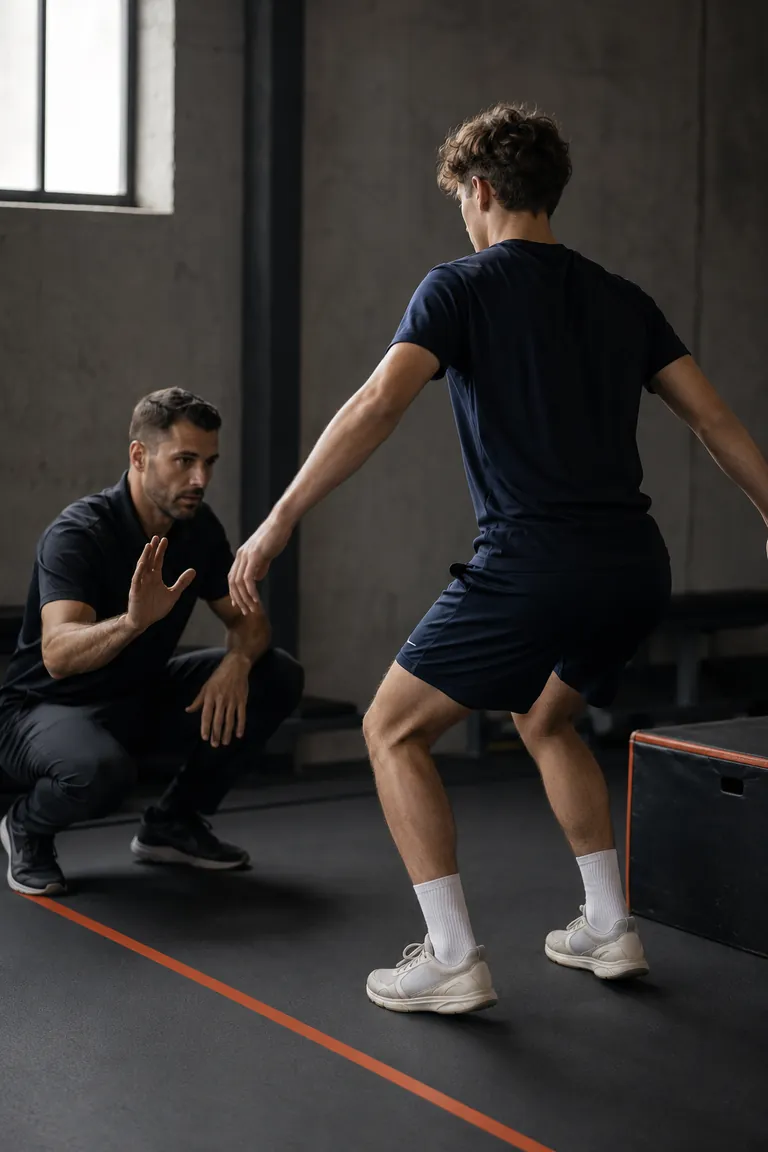
The 2014 international consensus on youth resistance training supports properly supervised strength work for children. At 11, that means bodyweight squats, lunges, planks, step-ups, push-ups and single-leg balance, taught with good form. Jumping and landing from low heights are worth practising because football is full of them. A warm-up built on that idea, such as the FIFA 11+ reviewed in the references, can be shortened and simplified for this age.
Technique matters more than load. If a child cannot do a controlled single-leg squat to a box, there is no reason to add weight. Our post on whether a 10 year old can lift weights explains the same principle.
A sample week for an 11 year old
This is generic exercise science, not an EvoQuest prescription. The shape of a good week is a few team sessions based on games, a short body-control block and real rest days.
What to avoid at 11
Avoid long continuous running as a punishment or a fitness test. Avoid playing a single position, usually striker or goalkeeper, for every match of the year. Avoid training on every day of the week with no rest, and avoid chasing a six-pack or a heavy gym programme.
Heel pain after running, known as Sever disease, is common around this age in children who play on hard grounds. It needs a doctor or physio to confirm, so do not guess.
School and academy context in India
An 11 year old is usually in Class 6, with the first real jump in homework and tuition. Football often fits into early mornings or evenings, and in Tamil Nadu the midday heat is a reason to move sessions earlier or later. Water breaks every 15 to 20 minutes and a light cap help in hot weather.
Many district-level children play on hard, uneven grounds. Footwear that suits the surface and a sleep window of 9 to 11 hours matter more than any extra drill. Let a child also play other sports at school, such as kho kho or athletics.
What EvoQuest measures at 11
EvoQuest in Ramanathapuram, Coimbatore works with young athletes from age 9. For a young footballer the lab can record jump height and landing on force plates, 10 m and 20 m speed on timing gates and basic movement quality with motion analysis. The result is a personal baseline for the child, not a ranking against others.
A free 20-minute call on the call page is the easiest way to ask whether an assessment suits your child.
Frequently asked questions
Should an 11 year old do strength training for football?
Yes, in a simple form. Bodyweight squats, lunges, planks and landing practice, supervised and taught with good technique, fit the international youth resistance training consensus. Heavy loading is not needed yet. Progress when the child controls the movement well.
How long should an 11 year old football session last?
Around 60 to 75 minutes of mostly ball-based play is plenty, with breaks for water. Longer sessions tend to fill with standing around. If a child is tired and sloppy near the end, the session has already run past its useful point.
Is running laps good for football fitness at 11?
Not as a main method. Football is made of short sprints, turns and stops, so small-sided games train the right qualities and keep a child interested. A few relaxed laps in a warm-up are harmless, but long laps should not be the fitness plan.
Can a child play football every day?
Playing freely is fine, but structured training on every day with no rest raises overuse risk, such as heel and knee pain. Keep some days free of organised sessions and let the child try other sports, which also builds general coordination.
When can my child have a fitness assessment?
EvoQuest works with young athletes from age 9. An assessment at 11 gives a personal baseline for jumping, speed and movement quality, which is useful to compare against the same child later as they grow. You can ask about it on a free 20-minute call.
This article is general education. Train within your current ability and get coaching if you are unsure about technique.
References
- National Strength and Conditioning Association position statement on long-term athletic development (Lloyd et al., 2016) Journal of Strength and Conditioning Research
- Position statement on youth resistance training: the 2014 International Consensus (Lloyd et al.) British Journal of Sports Medicine
- The FIFA 11+ injury prevention program for soccer players: a systematic review BMC Sports Science, Medicine and Rehabilitation
Cibiraj studied Exercise and Sports Science at Deakin University in Australia and worked as a strength and conditioning coach for cricket and football clubs in Melbourne before founding EvoQuest in Coimbatore. He runs the performance assessments and writes every diagnostics report, so the person who measures you is the one who explains the numbers.