
Football fitness training for 9 year olds: play first, build the base
A 9 year old footballer needs ball-based games, running and jumping skills, balance and plenty of variety, not adult fitness sessions. Short, playful circuits of 10 to 15 minutes beside normal practice build coordination and confidence. Weights are not needed, and rest days, sleep and other sports matter just as much.
 Cibiraj Sathishkumar · Accredited Exercise and Sports Scientist, Founder of EvoQuest
Updated · 4 min read
Key takeaways
- Nine is an age for learning to run, jump, turn and land well while holding a ball.
- Games with many touches do more for a 9 year old than laps or sprints in a line.
- Bodyweight skills, balance and light core play are enough; formal lifting is not needed.
- A child this age tires from boredom before muscles, so change the task every few minutes.
- Keep football to a share of the week and leave room for other sports and free play.
On this page
Where a 9 year old is in growth and development
Most children at nine are still well before their growth spurt. Limbs grow steadily, coordination improves quickly, and the nervous system is ready to learn new movement patterns. The long-term athletic development guidance from the NSCA describes this as a period to build broad fundamental movement skills before narrowing to one sport.
The same guidance says strength can improve at this age through play, climbing, hopping and bodyweight tasks, so there is no need for a gym. A child who can skip, hop on one leg, catch a ball while moving and change direction without tripping is building the base that football needs later.
Class 4 timetables in most Indian schools leave one or two games periods and the evening. That is enough time to play, as long as the child is not also running to coaching, tuition and a second sport every day.
What football fitness looks like at 9
At this age fitness comes from the football itself. Small-sided games such as 3 v 3 or 4 v 4 give every child dozens of touches, many short sprints and constant turning, which is far more useful than a long jog around the pitch.
On top of that, a coach or parent can add short movement games: tag with a ball under the arm, follow-the-leader with hops and skips, and relay races where the child has to stop on a line and balance for two seconds. The aim is to learn to start, stop and land under control.
Warm-up at this age works best as a game too. A few minutes of easy jogging, skipping and leg swings, followed by a ball game, prepares a child as well as any drill list. Hold stretching for the end of the session and keep it relaxed and brief.
A 12 minute circuit to add beside practice
One short circuit once or twice in a normal week is plenty. Use cones and a ball, keep every station under 40 seconds and rest between them.
If a child looks wobbly, shorten the station or make the cones wider rather than adding pace.
What to avoid at 9
Skip long-distance running as punishment, repeated sprint tests, and heavy kit or ankle weights. Avoid playing the same position every match, since goalkeepers and strikers at this age benefit from trying every role.
Another point is specialising too early. The IOC youth athletic development statement warns that narrowing to one sport very young adds injury and burnout risk without clear performance gain. Cricket in the street, swimming or a school athletics meet all feed football skill.
Watch for knee or heel pain after a spike in activity, such as a tournament week. Heel pain on running is common in this age range and should be looked at by a doctor or physiotherapist if it lasts more than a few days.
Sample week for a 9 year old
This is a generic pattern, not an EvoQuest prescription. Adjust to school and heat.
- Two football practices of 60 to 75 minutes, mostly small-sided games
- One school games period or a different sport such as swimming or badminton
- One short movement circuit like the one above, folded into a practice
- Free play with friends on at least two other days
- Two or more full rest days, with a bedtime that allows 9 to 11 hours of sleep
In Tamil Nadu summers, move sessions to early morning or after 5 pm and bring water to every break. Children heat up faster than adults and may not ask to stop.
How EvoQuest Sports Science can help
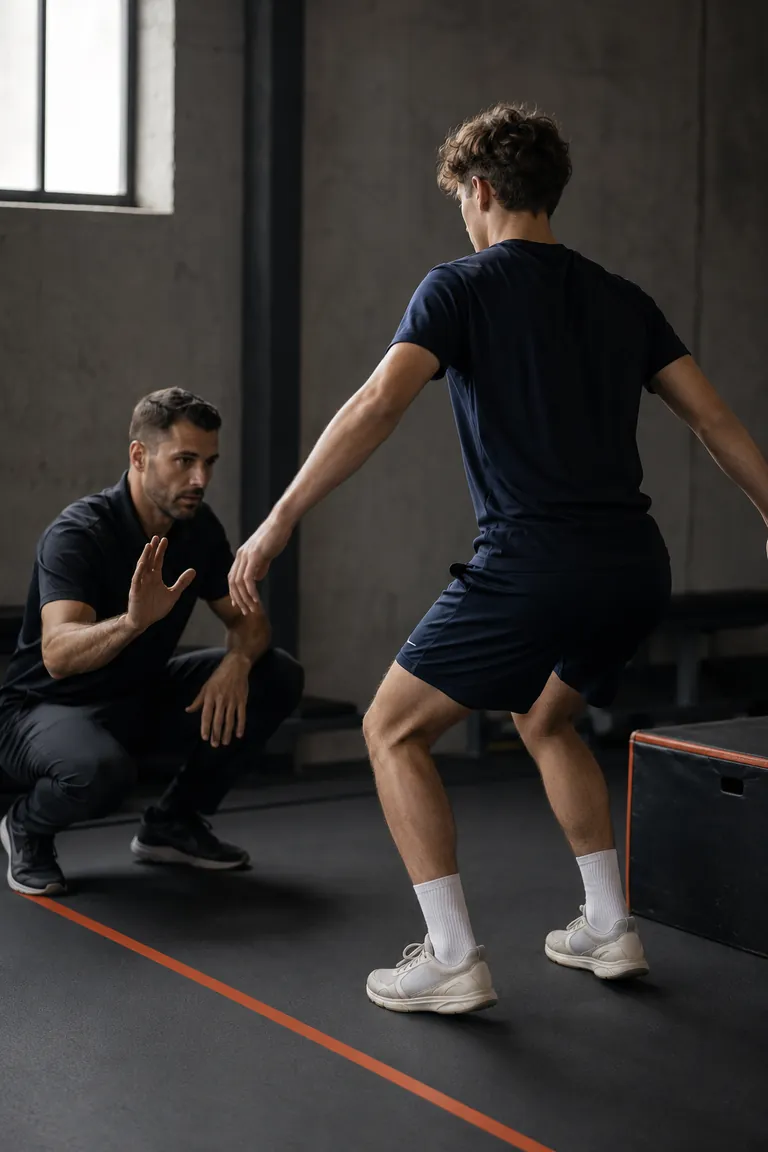
EvoQuest accepts young athletes from age 9. At this age the work is observation, not heavy testing: a coach watches how the child hops, lands, balances and changes direction, and parents get plain-language feedback on movement quality. If you want to talk about whether a lab visit makes sense for your child, the free 20-minute call is the place to start.
Frequently asked questions
What exercises are good for a 9 year old football player?
Running and jumping games, hopping and landing on one leg, bear and crab walks, balance holds, and dribbling around cones are all suitable. They build coordination and body control. Formal weight training is not needed, and any strength work should be bodyweight, short and supervised.
Can a 9 year old do sprints and agility drills?
Yes, in short bursts of 5 to 20 metres inside games, with full rest between efforts. The goal is clean starts, stops and turns. Avoid repeated timed sprints or long conditioning runs, which add fatigue without teaching the child anything useful at this age.
How many days a week should a 9 year old play football?
There is no single number, but the long-term development guidance recommends variety. A reasonable pattern is a couple of football practices plus a match, other sports or free play, and clear rest days. If your child is tired, irritable or has lingering pain, reduce the load.
Is it safe for a 9 year old to lift weights?
Supervised resistance training with a qualified adult can be safe for children, according to the 2014 international consensus, but it is not needed at nine. Bodyweight play covers the same goals. If a child is interested, keep loads light, technique first, and avoid maximal lifts.
This article is general education. Train within your current ability and get coaching if you are unsure about technique.
References
- National Strength and Conditioning Association position statement on long-term athletic development (Lloyd et al., 2016) Journal of Strength and Conditioning Research
- International Olympic Committee consensus statement on youth athletic development British Journal of Sports Medicine
- Position statement on youth resistance training: the 2014 International Consensus British Journal of Sports Medicine, Lloyd et al., 2014
- World Health Organization 2020 guidelines on physical activity and sedentary behaviour British Journal of Sports Medicine
Cibiraj studied Exercise and Sports Science at Deakin University in Australia and worked as a strength and conditioning coach for cricket and football clubs in Melbourne before founding EvoQuest in Coimbatore. He runs the performance assessments and writes every diagnostics report, so the person who measures you is the one who explains the numbers.