
What is a VBT device and how does it measure bar speed?
A VBT device measures how fast a barbell or body moves during a lift, usually in metres per second. Types include linear position transducers, inertial sensors and phone camera apps. Reviews find most inertial sensors are valid and reliable for straight barbell lifts. The device matters less than using it consistently.
 Cibiraj Sathishkumar · Accredited Exercise and Sports Scientist, Founder of EvoQuest
Updated · 5 min read
Key takeaways
- VBT devices show bar speed after every rep, which gives immediate feedback on effort and fatigue.
- Main types are linear position transducers, inertial sensors on the bar or body, and camera-based apps.
- A systematic review found the great majority of inertial sensors are valid and reliable for linear barbell movements.
- Lifts with curved bar paths, such as cleans, are harder to measure accurately.
- EvoQuest uses velocity-based training tools in its strength work and lab assessment.
On this page
What a VBT device is
Velocity-based training (VBT) uses the speed of the bar to guide training. A VBT device is the hardware that measures that speed. It attaches to the barbell, to the athlete or sits on the floor, and shows a number after each rep, such as 0.65 metres per second.
The idea behind it is that speed tells you how hard a rep really was. A weight that moves at a certain speed on a fresh day will move slower on a tired day. By reading speed, a coach can adjust the load for the day instead of following a fixed percentage written weeks earlier. Our guide to velocity-based training covers the method, and best VBT devices compares products. This post explains the hardware.
Typical velocities give a feel for the scale. A heavy squat near a maximal effort may move at around 0.3 metres per second, while a light jump squat can move above 1 metre per second. The exact numbers depend on the lift, the athlete and the device, so each athlete builds their own reference values.
How VBT devices work
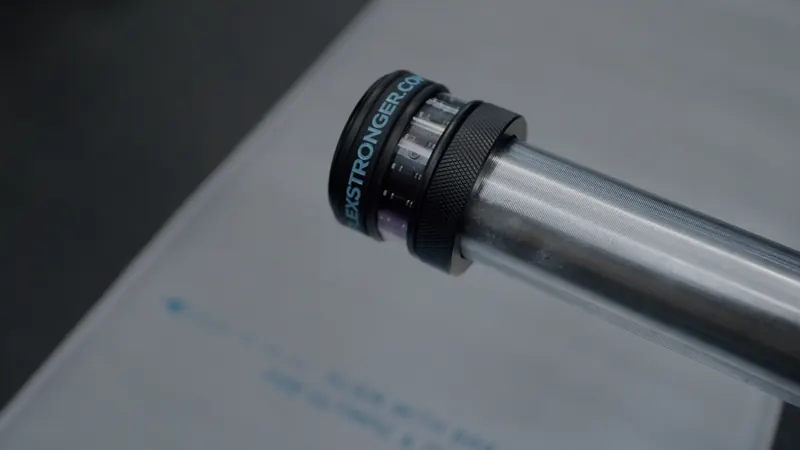
Three technologies dominate. A linear position transducer (LPT) has a cable that clips to the bar and a spool in a box on the floor. As the bar moves, the cable unwinds, and the unit records its position many times a second. Velocity is calculated from how fast the position changes.
Inertial sensors, which contain an accelerometer and gyroscope, attach to the bar or to a sleeve and estimate velocity by processing acceleration over time. Camera apps track the bar or a marker in video, using the known size of a plate to convert pixels to distance.
All of them then divide the lift into phases and report values such as mean concentric velocity, the average speed of the lifting phase, and peak velocity. Mean concentric velocity is the most commonly used number for load prescription, while peak velocity suits fast lifts.
What athletes and coaches learn
The device gives instant feedback. Athletes tend to push harder when they can see the number, which is useful for power work. Coaches can set a velocity target for a set and stop when speed drops by a chosen amount, for example 20% from the first rep. That helps manage fatigue within the session.
It also enables load-velocity profiles. By lifting a few loads and plotting speed against weight, a coach can estimate an athlete's one-rep max without a maximal attempt, and see day-to-day readiness from how fast the bar moves at a fixed weight. A drop in speed at the same load across a week can signal tiredness before the athlete reports it.
The device does not replace judgment. Technique, pain and context still come first. See velocity-based training versus percentage-based training for the planning side.
Teenagers and beginners can use the display as a coaching cue. Telling a young lifter to move the bar as fast as they can with control is easier when they can see the result, and it keeps attention on technique and intent instead of on how heavy the weight is.
VBT devices compared with cheaper options
Bar speed can be tracked in several ways. The table compares them.
Reps in reserve, where the athlete stops a set when they feel they could do about two more, is a free alternative that works well for experienced lifters.
Accuracy and limits
A systematic review of the validity and reliability of inertial sensors for barbell velocity concluded that the great majority of inertial sensors used for linear barbell trajectories are valid and reliable, and can be used by coaches for monitoring external load. For other movements, such as fast Olympic lifts with curved paths, accuracy is lower.
The Weakley and colleagues review in the Strength and Conditioning Journal sets out the framework for VBT: feedback, load-velocity profiles, velocity loss thresholds and monitoring. It stresses that the method needs consistent measurement of the same exercise with the same technique, because load-velocity relationships are specific to each lift.
Practical issues include sensor placement, range of motion, pause lengths and software settings. Numbers from one device are not interchangeable with those from another, so choose one device and stay with it. Do not use bar speed to judge a lift performed with poor technique.
Getting good data
Attach the device in the same position each time, and check that the cable or sensor is secure and does not touch the athlete. Use the same lift, grip, stance and range of motion. Define whether the rep starts from a pause or from a bounce, since that changes velocity.
Warm up and ask the athlete to move the bar as fast as they can in the lifting phase, even with heavy loads, because intent affects velocity. Log the first rep of each set and the final rep, and note sleep, soreness and time of day.
Review data in trends. One slow session is a prompt to check on the athlete, not a reason to change the whole plan.
When you compare devices, ask three questions. Which exercises has it been validated for? Does it report mean or peak velocity? Can you export the raw data? Those answers matter more than the brand name.
VBT devices at EvoQuest
EvoQuest uses velocity-based training tools in its strength work and in the lab assessment in Ramanathapuram, Coimbatore, to build load-velocity profiles and adjust training. Youth athletes use bar speed mainly for feedback and learning technique, with light loads and close supervision.
See the strength and conditioning page for how this fits into programmes.
If you want to know whether a test like this suits your sport or your child, start with a free 20-minute call on the call page or WhatsApp +91 93440 48834.
Frequently asked questions
What does a VBT device measure?
A VBT device measures how fast a barbell or body moves during an exercise, usually reporting mean and peak velocity in metres per second after each rep. Coaches use the data to adjust load, stop sets when speed drops too much and track readiness. Most also estimate power.
Are VBT devices accurate?
A systematic review found the great majority of inertial sensors are valid and reliable for linear barbell movements. Accuracy is lower for curved bar paths. Linear position transducers are often treated as the practical reference. Use one device and one protocol consistently.
Do I need a VBT device to train well?
No. Percentage-based plans and reps-in-reserve can work well, especially for beginners. A VBT device helps when you want objective feedback on speed, fatigue and daily readiness, and it suits power-focused athletes who benefit from seeing every rep. Start with a good plan first.
Can my phone work as a VBT device?
Camera-based apps can estimate bar speed and are a low-cost way to start. Accuracy depends on camera angle, lighting and set-up, and comparison with dedicated devices is limited. Use the same phone position every session and compare only with your own history.
Is velocity-based training safe for teenagers?
It can be, with light loads, good technique and qualified supervision. In young athletes, bar speed is most helpful as feedback for moving fast with control, as in the NSCA long-term athletic development approach. Heavy maximal testing is not needed. Always keep technique first.
This article is general education. Train within your current ability and get coaching if you are unsure about technique.
References
- Velocity-based training: from theory to application (Weakley et al.) Strength and Conditioning Journal
- Validity and reliability of the inertial measurement unit for barbell velocity assessments: a systematic review Systematic review (PubMed 33916801)
- National Strength and Conditioning Association position statement on long-term athletic development Journal of Strength and Conditioning Research
Cibiraj studied Exercise and Sports Science at Deakin University in Australia and worked as a strength and conditioning coach for cricket and football clubs in Melbourne before founding EvoQuest in Coimbatore. He runs the performance assessments and writes every diagnostics report, so the person who measures you is the one who explains the numbers.