
Sports performance assessment for youth athletes in Coimbatore: what parents need to know
A youth sports performance assessment in Coimbatore measures a young athlete's movement quality, strength, speed, power and fitness with age-appropriate tests. EvoQuest Sports Science offers it from age 9 in Ramanathapuram, with a supervised three-hour session, a parent debrief and a safe starting plan.
 Cibiraj Sathishkumar · Accredited Exercise and Sports Scientist, Founder of EvoQuest
Updated · 6 min read
Key takeaways
- Youth athletes can take a performance assessment from age 9 in a supervised, age-appropriate format.
- The goal is a baseline and a safe plan, not a ranking against other children.
- NSCA and the 2014 international consensus support well-supervised strength training for children and teenagers.
- Parents are welcome to attend the results session and ask questions.
- If a child has pain or an injury, see a doctor or physio before booking.
On this page
- Why assess a young athlete at all
- Is it safe?
- What is tested
- What the session feels like for a child
- The parent debrief and plan
- Growth, maturation and why timing matters
- What a baseline can show a parent
- Warm-ups and injury prevention for young athletes
- Worked example: a 14-year-old cricketer
- Which young athletes benefit
- How to book for your child
- FAQs
Why assess a young athlete at all
Children and teenagers change fast. Height, limb length and strength shift from year to year, and sometimes within months. An assessment gives parents and coaches a baseline for where the athlete stands now, so training can match their stage instead of copying an adult programme.
The aim is not to select or reject anyone. It is to find out what a young athlete does well, which movements need practice, and what is a sensible next step for their sport.
The NSCA position statement on long-term athletic development argues that all young people should build general movement skill and physical fitness, with training progressing as they mature. An assessment is one way to put that into practice.
Is it safe?
Supervised strength and conditioning is considered safe and beneficial for children and adolescents. The 2014 international consensus statement published in the British Journal of Sports Medicine, and the earlier NSCA position paper, both say that well-designed youth resistance training, delivered by qualified professionals, can improve strength, motor skills and resilience to sports injury.
Safety depends on supervision, technique, sensible loads and rest. In our assessment, young athletes use bodyweight or light loads, learn each movement first, and stop if anything hurts. Maximal-effort tests are limited to those where technique is secure.
Our guide Is strength training safe for kids goes into the research in more detail.
What is tested
The session is built around the child's sport, age and experience. The following table shows the usual areas.
We do not run tests that would put young joints at risk, and we do not compare a child with a published adult norm. We compare the child with their own results over time.
What the session feels like for a child
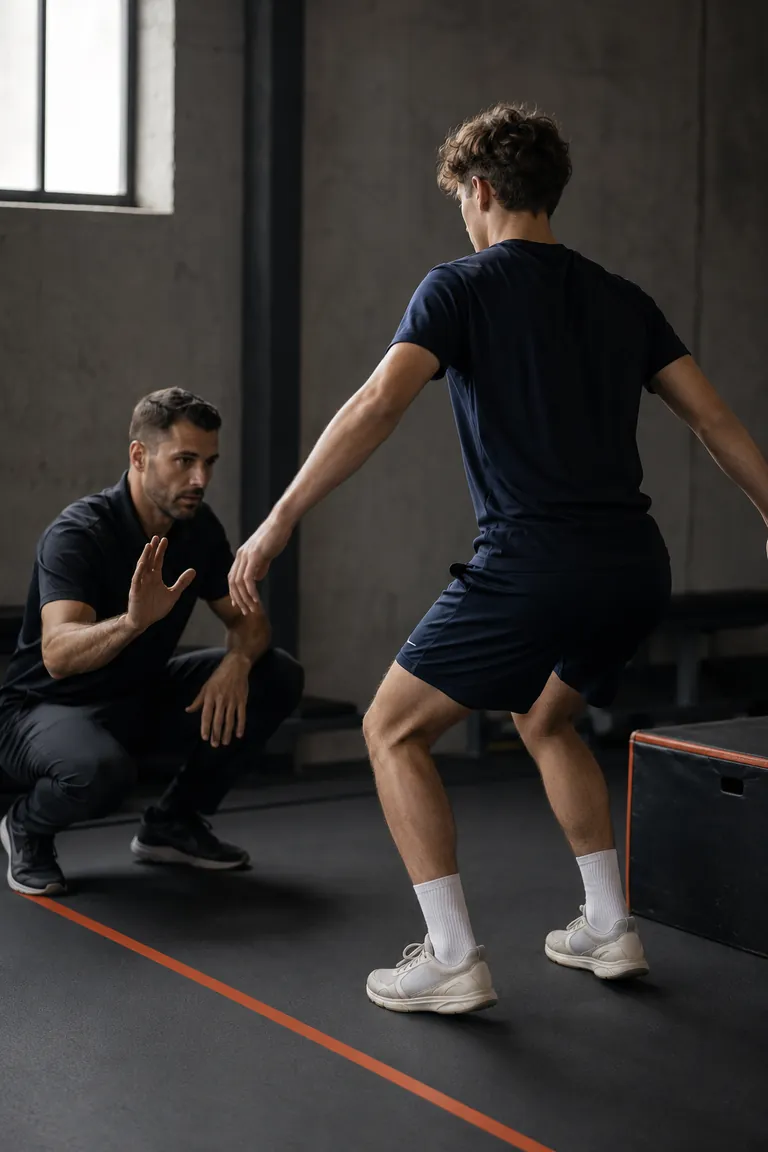
We want children to enjoy the session. The coach explains each task in simple words, demonstrates it and lets the child practise before recording. Rest breaks are frequent, and the pace follows the child.
Children with little training experience often enjoy the lab equipment. Jumping on the plates or racing through the timing gates feels like a game. Sports-minded children learn that being strong and fast is a skill that can be improved with planning.
Parents can stay in the room or watch from outside, depending on what the child prefers. We recommend that parents bring a water bottle, a snack and the child's usual sports shoes.
The parent debrief and plan
After the testing, the coach meets with the parent and the child. We explain the results in simple terms and discuss what to prioritise.
For many young athletes, the first priorities are movement skill, balanced strength and a good warm-up routine. The plan may suggest strength work with bodyweight and light loads, jumping and landing practice, and sport-specific drills. For footballers and other field players, the FIFA 11+ warm-up has strong research behind it. A cluster randomised trial in young female footballers found that it reduced injuries overall and severe injuries, so we often recommend teams adopt a structured warm-up like it.
The plan can run at our strength and conditioning programme in Coimbatore, at school with a coach, or online via remote coaching. We do not push the child to specialise early or to train every day for one sport.
Growth, maturation and why timing matters
Young athletes do not grow at the same rate. Two 13-year-olds can differ by several years in biological maturity, and that difference shows up in strength, speed and injury risk. During a growth spurt, limbs lengthen quickly and coordination can briefly drop, so a child who used to move smoothly may seem clumsy for a few months.
This is one reason we avoid fixed standards for children. A single number means little unless you know the child's age, growth stage and training history. We track change within the same child, and we adjust the plan when growth changes how the child moves.
Parents can help by noting sudden increases in height, recurring pain around the knees or heels and any drop in energy. These are worth sharing with the coach and, when pain persists, with a doctor or physio.
What a baseline can show a parent
A baseline helps in several practical ways. It shows whether a child is balanced from side to side, whether their jump and landing technique looks controlled, and how their speed and fitness compare with their own earlier results.
It also supports good decisions about training. If a child is already playing five days a week, the plan might focus on recovery and warm-up quality instead of extra sessions. If the child has little structured activity, the plan builds basic strength and skill first.
Retesting after a season or a training block shows whether the changes are working. Many parents find this reassuring because it replaces guesswork with evidence.
Warm-ups and injury prevention for young athletes
A good warm-up is one of the simplest ways to lower injury risk in young athletes. In a cluster randomised trial published in the BMJ, young female footballers aged 13 to 17 followed the FIFA 11+ programme, and the researchers reported fewer injuries overall and fewer severe and overuse injuries.
For ACL risk specifically, a meta-analysis of neuromuscular training in young females found that programmes combining strength and control exercises were more effective than programmes with a single type of exercise. You can read more in our guide on how to prevent ACL injury in athletes.
In the assessment, the coach can show your child a warm-up that fits their sport and can be repeated at school or at the club.
Worked example: a 14-year-old cricketer
This is an illustration, not a real athlete. A 14-year-old fast bowling prospect from a school team has grown several centimetres in a year. His parents worry about his back after long spells.
They see a doctor or physio first and get clearance for sports activity. At the lab, the coach screens his landing and trunk control, runs jump and sprint tests with timing gates and force plates, and measures fitness. Bowling load is discussed, because rapid increases in workload are a concern in young fast bowlers.
The plan focuses on trunk and hip strength, landing control, sensible bowling workload with rest days, and light strength work with bodyweight. A retest is planned after a season block, and results are compared with his own earlier numbers only.
Which young athletes benefit
Young athletes benefit when they are serious enough about their sport to want structured preparation, or when a parent wants peace of mind about safe loading.
- Children aged 9 to 12 who are starting organised sport and need movement basics.
- Teenagers entering a growth spurt who want a plan that respects changing bodies.
- School and academy players preparing for trials or state events.
- Youth athletes who have recovered from injury and have physio clearance.
- Siblings and teammates who can share the visit and train together.
For a broader look at how the assessment works, read what is athlete assessment.
How to book for your child
Start with the free 20-minute call. Tell us the child's age, sport, training history, any injuries and any medical conditions. We will say whether the assessment suits them now and what to bring.
You can book through the booking form, the call page or WhatsApp +91 93440 48834. Parents with questions about fees can ask on the call, where we give an answer that fits the child's needs. The assessment takes place in Ramanathapuram, Coimbatore.
Frequently asked questions
At what age can a child have a sports performance assessment?
EvoQuest assesses youth athletes from age 9. The tests are age-appropriate and supervised, and they focus on movement quality, general strength, speed and fitness. Younger children can usually start with movement skill programmes instead.
Is strength testing safe for children?
When it is supervised and technique is sound, yes. The NSCA position statement and the 2014 international consensus both support youth resistance training under qualified supervision. Tests use bodyweight or light loads, and any pain stops the session.
What should my child bring to the assessment?
Bring sports clothes, the shoes your child trains in, water, a small snack and notes on any past injuries or medical conditions. If a physio has cleared your child after an injury, bring that note too.
Will my child be compared with other children?
No. We compare your child with their own results over time. The assessment builds a baseline so progress can be tracked, and we do not rank children against each other or against adult standards.
Can parents stay during the session?
Yes. Parents can stay in the room or watch from outside, depending on what the child prefers. The results discussion is held with the parent and the child so everyone understands the plan.
Can we continue training online after the assessment?
Yes. If you live outside Coimbatore, the plan can run through EvoQuest remote coaching, or you can take it to a school or academy coach. Start with a free 20-minute call to choose the right route.
This article is general education, not medical advice. If you have pain, a recent injury or a medical condition, see a doctor or physiotherapist before training.
References
- Position statement on youth resistance training: the 2014 International Consensus British Journal of Sports Medicine
- Youth resistance training: updated position statement paper from the National Strength and Conditioning Association Journal of Strength and Conditioning Research
- National Strength and Conditioning Association position statement on long-term athletic development Journal of Strength and Conditioning Research
- Comprehensive warm-up programme to prevent injuries in young female footballers: cluster randomised controlled trial (Soligard et al.) BMJ
Cibiraj studied Exercise and Sports Science at Deakin University in Australia and worked as a strength and conditioning coach for cricket and football clubs in Melbourne before founding EvoQuest in Coimbatore. He runs the performance assessments and writes every diagnostics report, so the person who measures you is the one who explains the numbers.