
Skinfold test norms: average and good scores
Skinfold results depend on the sites measured, the caliper, the tester and the equation used to turn millimetres into body fat percent, so published charts disagree. We found no verified athlete table we could open, so we print none. Track the raw sum of skinfolds in millimetres, measured by the same trained person.
 Cibiraj Sathishkumar · Accredited Exercise and Sports Scientist, Founder of EvoQuest
Updated · 4 min read
Key takeaways
- A skinfold measure gives millimetres at several sites; body fat percent is a calculation added on top and depends on the equation.
- Different equations give different body fat percentages from the same measures.
- A narrative review argues skinfolds remain useful in applied sports practice when done by a trained measurer.
- No body composition method is perfect, so use the same method and tester over time.
- Squad ranges, z-scores and typical error from the same tester are the most defensible comparison.
On this page
What a skinfold test measures
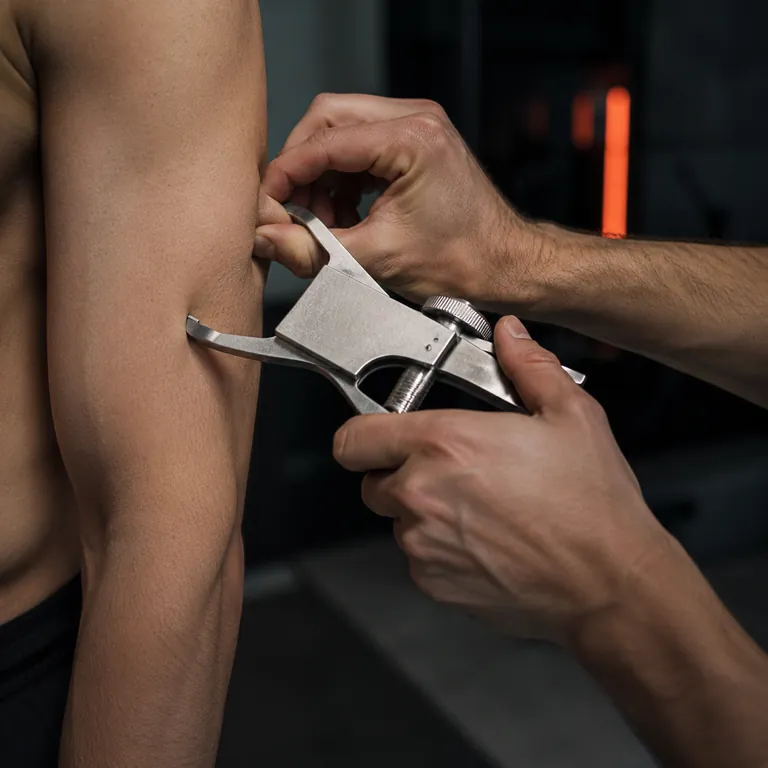
A skinfold test uses a caliper to measure the thickness of a fold of skin and fat at set body sites. The reading is in millimetres. Taking several sites and adding them gives a sum of skinfolds. Equations can convert the sum into body density or body fat percent. Each step adds error. See skinfold test explained for the sites and method.
The first rule for norms is that the number you compare must be the same kind. Millimetres cannot be compared with percentages, and a four-site sum cannot be compared with an eight-site sum.
Why published charts disagree
Body fat charts online use different equations, and the same measures can produce different percentages depending on the equation. Charts often do not name the sample, age or sex, or whether the equation was built on athletes. A chart built on sedentary adults can overestimate body fat in a muscular athlete.
We found no open skinfold table for athletes that we could open and verify, so we give no numbers. The narrative review "Come back skinfolds, all is forgiven" (Nutrients) examined the efficacy of common body composition methods in applied sports practice, and the title reflects its argument that skinfolds deserve a second look. It is a review of methods, not a table of norms.
How skinfolds compare with other methods
Other methods measure different things. DXA scans, discussed by Nana and colleagues in a paper on practicalities and limitations, estimate fat, lean and bone mass but depend on hydration, recent food and the scanner. Bioelectrical impedance is covered in a Nutrients narrative review on body composition assessment in athletes, with attention to quantitative and qualitative analysis. Each method has its own error.
Sources are in the references. None offers a universal skinfold norm for athletes.
Tester skill and technical error
Skinfold results depend on locating the exact site, marking it, pinching consistently and reading the caliper at the right time after application. Two testers can differ by a few millimetres on the same athlete, which is as large as many real changes. For this reason, the same trained person should measure the same athlete across time, using the same caliper.
Measure each site two or three times and use the mean, or the median if two readings differ much. Measure early in the day, before training and after a similar fluid intake, because hydration changes skinfold thickness slightly.
Why the raw sum is more honest
Reporting the sum of skinfolds in millimetres avoids the extra error from the body fat equation. If the sum falls by 8 mm over a block with a stable tester, that is clear evidence of less subcutaneous fat at those sites. A body fat percentage that falls by one point may be partly an equation effect. The sum cannot tell you about internal fat or lean mass, so it should be read with body mass and performance.
For young athletes, growth and puberty change body composition in ways that do not reflect poor training or diet. Avoid body fat targets for children, and avoid weight talk that could encourage disordered eating.
Build in-squad skinfold norms
Choose one site set, one caliper and one trained tester. Measure every athlete under similar conditions, and record the sum in millimetres. Compute the squad mean and standard deviation by sex and sport group, then z-scores: (the athlete's sum minus the squad mean) divided by the squad standard deviation. A sprinter and a goalkeeper may belong in different groups.
Find typical error, often called the technical error of measurement in this field, by having the tester measure a few athletes twice within a day or two. Set the smallest worthwhile change at 0.2 of the between-athlete standard deviation. In a squad with a standard deviation of 15 mm, that is 3 mm (invented illustration). A change smaller than the typical error should not be reported as real.
Using body composition data responsibly
Body composition numbers should support performance and health, not drive shame. Share results privately, focus on trends and link them to training, sleep and food, and avoid ranking athletes in front of a group. If an athlete shows signs of low energy availability or disordered eating, such as constant tiredness, missed periods or fear of food, involve a doctor or sports dietitian.
Body composition at EvoQuest
We measure body composition with methods suited to the athlete and report trends against the athlete's own baseline. Alongside it we track strength, jump and sprint output, so a change in mass can be read in terms of performance.
To discuss a measurement plan, book a free 20-minute call.
Frequently asked questions
What is a good skinfold score?
We found no verified athlete table, so we give no number. A good outcome is a stable or falling sum of skinfolds in millimetres, measured by the same trained person, that fits the athlete's health and performance.
Why do skinfold body fat charts differ?
Because they use different equations and sample groups to turn millimetres into percent. The same measures can give different body fat results, so compare only within one method.
Is a skinfold test accurate?
It is an estimate, and accuracy depends on tester skill and equation. A narrative review argues skinfolds still have value in applied sports practice when done well. Use the raw sum for tracking.
Should teenagers have their body fat measured?
Only with care. Growth changes body composition, and targets can harm body image. Keep results private, track trends and involve a doctor or dietitian if there are concerns.
How often should skinfolds be measured?
Every four to eight weeks is plenty, at the same time of day and by the same tester. Changes over days are mostly noise.
This article is general education. Train within your current ability and get coaching if you are unsure about technique.
References
- Come back skinfolds, all is forgiven: a narrative review of the efficacy of common body composition methods in applied sports practice Nutrients (PMC)
- Assessment of body composition in athletes: a narrative review of available methods with special reference to quantitative and qualitative bioimpedance analysis Nutrients (PMC)
- DXA for body composition assessment: practicalities and limitations (Nana et al.) Bond University research portal
Cibiraj studied Exercise and Sports Science at Deakin University in Australia and worked as a strength and conditioning coach for cricket and football clubs in Melbourne before founding EvoQuest in Coimbatore. He runs the performance assessments and writes every diagnostics report, so the person who measures you is the one who explains the numbers.