
Skinfold test explained: how it works and how far to trust it
A skinfold test uses calipers to pinch and measure the thickness of fat under the skin at set body sites. The readings are added into a sum in millimetres. A trained tester can track change in body fat with it cheaply, but the sum is more dependable than a body fat percentage worked out from an equation.
 Cibiraj Sathishkumar · Accredited Exercise and Sports Scientist, Founder of EvoQuest
Updated · 6 min read
Key takeaways
- Calipers measure the thickness of a fold of skin and fat at standard sites.
- A review of body composition methods recommends reporting the sum of skinfolds in mm, not an estimated body fat percentage.
- There are over one hundred equations for converting skinfolds to body fat percentage, and they can disagree by several points for the same person.
- Tester skill and site placement change the result, so one trained person should test.
- Skinfolds are quick, cheap and less affected by meals and hydration than some other methods.
On this page
What a skinfold test measures
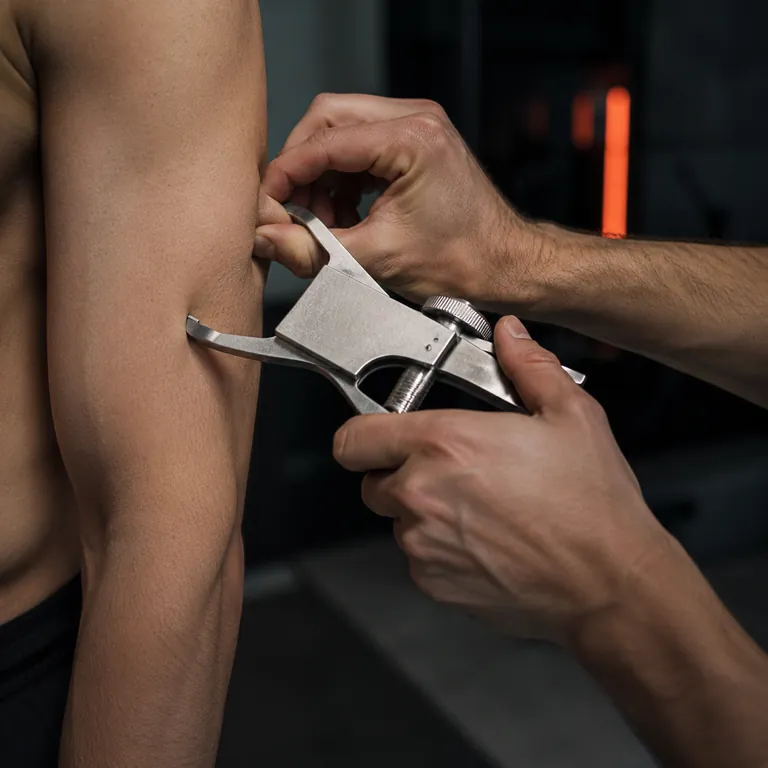
A skinfold test estimates how much fat sits just under the skin. The tester pinches a fold of skin and fat at a marked site and measures its thickness in millimetres with calipers. The test is repeated at several sites, such as the upper arm, the trunk and the thigh.
It does not measure total body fat directly. It measures subcutaneous fat at chosen sites and, from that, gives a picture of how fat levels are changing. The method has been used in sport for decades, and a 2021 narrative review in Nutrients by Kasper and colleagues is titled Come Back Skinfolds, All Is Forgiven for good reason: it argues skinfolds still deserve a place in applied sport.
How the test is done
- A trained tester marks each site on the athlete's body, using landmarks, while the athlete stands relaxed.
- The tester grips the skin and fat between thumb and finger about 1 cm away from the site and pulls it free of the muscle.
- The caliper is placed at the marked site and the reading is taken after a couple of seconds.
- The tester repeats each site and averages the readings, going round the sites in a fixed order.
- The readings are added into a sum in millimetres.
Test in the morning, before training and without a recent hard session, and keep the same tester. Skin temperature and sweat can change the fold, so a cool, dry room helps.
- 1
Prepare the athlete
Test in the morning, before training, with the athlete relaxed and the skin dry.
- 2
Mark the sites
A trained tester marks each site using body landmarks.
- 3
Grip the fold
Pinch the skin and fat about 1 cm from the site and pull it away from the muscle.
- 4
Place the caliper
Apply the caliper at the mark and read the thickness after a couple of seconds.
- 5
Repeat the sites
Go round the sites in the same order and repeat for a second reading, averaging the two.
- 6
Add the sum
Add the site readings into a sum in millimetres and record it with the date and tester name.
Sum of skinfolds versus body fat percentage
Many reports turn skinfolds into a body fat percentage with an equation. Kasper and colleagues point out there are over one hundred such equations, and they have not been validated for tracking regular changes. In their table, one male soccer player's estimated body fat ranged from 4.3% to 8.2% depending on the equation, and a rugby player's from 16.6% to 23.1%.
The same review states that the sum of skinfold thicknesses has a high degree of agreement with whole-body measures from DXA, so the authors recommend reporting the sum in millimetres. They also advise standardising on the sum of eight sites used by the ISAK method, because reports of sums of 4, 7 or 8 sites make comparison hard.
Sources of error
The same review lists what can go wrong. The method assumes constant skin thickness and compressibility across sites and people. Tester grip, caliper pressure, age, sex and skin temperature all affect the reading. Site placement matters a great deal: the authors note that as little as a 1 cm difference in the site can have significant effects. Even among ISAK-accredited testers there can be large discrepancies, particularly in larger athletes.
The practical rule is simple. Use one tester, one set of calipers and one protocol, and read changes as a trend over weeks, not a single reading. A small change between two tests may be inside the error.
How skinfolds compare with DXA and bioimpedance
The review rates DXA as the better choice when bone or limb-specific data are needed, but notes it is sensitive to conditions. A meal increased measured fat mass by up to 2.6%, and changes in glycogen shifted lean mass by about 2.5%. Bioimpedance results conflict with DXA in athletes and depend on hydration and temperature. Skinfolds were described as the least affected by meals and hydration, and good value for cost, speed and standardisation.
The authors concluded that for simple tracking of body fatness, skinfolds reported as a sum of eight sites may be the best option. Our posts on skinfold versus DXA and the DXA body fat test compare the two in detail.
Who should be careful
Body measurements can affect how some young people feel about their bodies. Do not test children or teenagers just to chase a low number, and avoid sharing scores in a group. For young athletes, follow NSCA youth guidance and keep the focus on growth, health and performance. Body fat targets are individual, and very low levels are not healthy for everyone.
Using the result
Read a skinfold sum as a trend. If the sum falls over a block while strength and sprint times hold, the change is likely to be a favourable one. If the sum falls and performance drops too, the athlete may be cutting too hard. Pair the sum with weight, performance tests and how the athlete feels. For a wider look, see our guide to BMI versus body fat for athletes.
When skinfolds are a good choice
Skinfolds make sense when you need a cheap, quick way to follow body fat across weeks, with a trained person doing the measuring. They suit squads, schools and clubs where a scan is not practical, and they are less affected by food and hydration on the day than some other methods, according to the Nutrients review.
They are a weaker choice when you need lean mass, bone or limb detail, in which case DXA is preferred, or when no trained tester is available. Skinfolds only sample fat under the skin, so they say little about fat stored deeper in the body.
Think about how the result will be used. If the goal is a performance and health check, a trend in the sum of skinfolds paired with strength, speed and energy levels gives more than a single body fat percentage. If the goal is to compare athletes with each other, remember that equations and testers differ, and that a gap of a couple of percentage points can fall within the error.
Plan the schedule so that testing is repeatable: morning, same tester, same sites, same day of the week, and similar training in the day before. Record results in a simple sheet with the date, tester, sites and sum. If you change tester, do a few overlap tests so that you know the difference between them.
Body composition at EvoQuest
At EvoQuest in Ramanathapuram, Coimbatore, body composition is one part of the lab assessment, and the coach explains what each method can and cannot show. See the performance diagnostics page, or ask about your goals on a free 20-minute call through the call page.
Frequently asked questions
What is a skinfold test?
It is a method that uses calipers to measure the thickness of a fold of skin and fat at standard body sites. The readings are added to give a sum in millimetres, which helps track changes in body fat.
How accurate is a skinfold test?
It depends on the tester, the sites and the equation. Site position changes of about 1 cm can matter, and estimated body fat percentages can differ by several points between equations. The sum of skinfolds in mm is more dependable for tracking.
Should I report skinfolds as body fat percent?
A narrative review recommends reporting the sum in mm because over one hundred equations exist and they have not been validated for tracking change. The percentage can look precise while being wrong by several points.
How often should skinfolds be measured?
Often enough to see a trend, but not so often that small errors look like change. Every few weeks is common in practice. Use the same tester and conditions each time.
Is a skinfold test better than DXA?
They suit different jobs. Skinfolds are cheap, quick and less affected by meals and hydration, while DXA gives bone and limb data. A review found the sum of skinfolds agrees well with DXA for whole-body fatness.
This article is general education. Train within your current ability and get coaching if you are unsure about technique.
References
- Come back skinfolds, all is forgiven: a narrative review of the efficacy of common body composition methods in applied sports practice (Kasper et al.) Nutrients, 2021
- Assessment of body composition in athletes: a narrative review of available methods with special reference to quantitative and qualitative bioimpedance analysis Nutrients
Cibiraj studied Exercise and Sports Science at Deakin University in Australia and worked as a strength and conditioning coach for cricket and football clubs in Melbourne before founding EvoQuest in Coimbatore. He runs the performance assessments and writes every diagnostics report, so the person who measures you is the one who explains the numbers.