
How to do a plank properly (and how long to hold it)
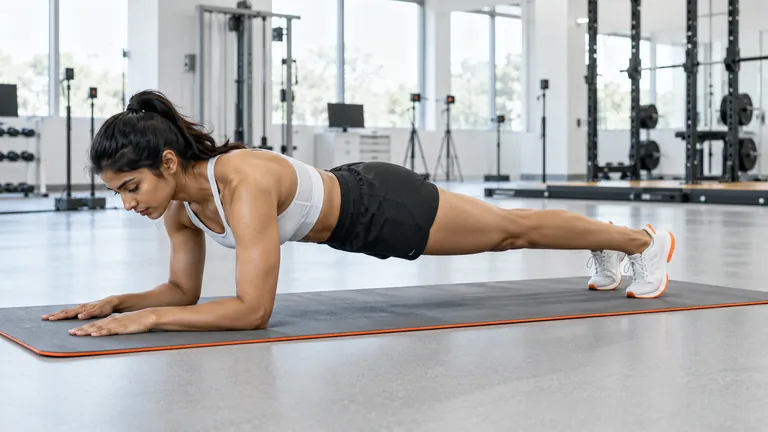
Place your elbows under your shoulders, forearms parallel, and make a straight line from head to heels. Squeeze your glutes, tuck the ribs down and breathe steadily. Hold for quality, not time: stop when your hips sag or pike. Short, hard 10 to 30 second holds beat long, sloppy ones.
 Cibiraj Sathishkumar · Accredited Exercise and Sports Scientist, Founder of EvoQuest
Updated · 8 min read
Key takeaways
- A good plank is a full-body brace: glutes squeezed, ribs tucked, shoulders pressing the floor away.
- Quality beats duration. Stop the set when the hips sag, not when a timer says so.
- Research shows modified planks (posterior tilt, long lever) can increase abdominal activation versus the basic plank.
- Dead bug, bird dog and side planks cover the trunk from other angles and are often easier to progress.
- Planks build trunk endurance, but sport also needs rotation, anti-rotation and power work.
On this page
- Why people search "how to do a plank"
- Muscles worked and the biomechanics
- Step-by-step: the proper forearm plank
- Common plank mistakes and fixes
- How long should you hold a plank?
- A simple plank routine you can follow
- Plank progressions and the rising variations
- Are planks enough for a strong core?
- Safety, youth and special cases
- Plank variations explained
- Planks for runners, cricketers and school tests
- Plank myths worth dropping
- How EvoQuest measures trunk control
- FAQs
Why people search "how to do a plank"
Plank is the most searched exercise in India among the basics, and the question "how to do a plank" has surged in recent months. It is easy to see why: a plank looks simple, needs no equipment and often shows up in school, gym and army fitness lists.
The trouble is that most people hold a plank badly. Hips sag, shoulders shrug, the neck pokes forward and the timer becomes a pain endurance contest. A long hold in that position mainly trains your ability to tolerate discomfort, not a stable trunk.
A proper plank trains the trunk to resist movement. The abs, obliques and deep trunk muscles brace to stop the spine from sagging, the hips from rotating and the ribs from flaring. That job helps in sprinting, bowling, throwing, tackling and holding a clean position in a lift. This guide shows how to build a plank you can trust and how to move on to variations that matter.
Muscles worked and the biomechanics
The plank is an isometric exercise: the muscles contract without the joints moving. Gravity pulls the hips down, so the trunk muscles have to hold the line.
Not all planks recruit the trunk equally. A long-lever, posterior-tilt version, where the elbows sit further forward and the pelvis tilts back, showed higher upper rectus abdominis, lower abdominal and external oblique activation than the traditional plank in an EMG comparison. In a 2023 EMG study, head position changed core muscle activity as well. Escamilla and colleagues, in a 2016 Sports Health paper, also pointed out that high core activity is associated with high spinal compressive loading, which is a reason to prefer well-chosen holds over endless holds.
These are small studies on healthy volunteers. Use them to refine technique, not to claim that one plank beats all others.
- 1
Position the elbows
Lie face down, then place the elbows under the shoulders with the forearms parallel.
- 2
Lift into a straight line
Curl the toes under and raise the body so you rest on forearms and toes in one line from head to heels.
- 3
Brace
Push the floor away, squeeze the glutes and tuck the ribs down toward the pelvis.
- 4
Hold with steady breathing
Keep the neck long and breathe in and out without holding your breath.
- 5
End the set at the first form break
Stop when the hips sag or pike and rest 30 seconds before the next hold.
Step-by-step: the proper forearm plank
- Lie face down. Place your elbows directly under your shoulders and forearms parallel, palms flat or hands loosely clasped.
- Curl your toes under and lift the body so you rest on your forearms and toes. Feet can be hip width apart; a wider stance is easier.
- Push the floor away so the shoulder blades spread. Your upper back should not sag between them.
- Squeeze the glutes and tuck the ribs down toward the pelvis. Imagine pulling the front of the ribs toward the belt line.
- Keep the neck long with the eyes looking at the floor just ahead of your hands.
- Breathe in and out steadily. Do not hold your breath.
- End the set when the hips drop, rise or shift, or when you cannot breathe steadily.
Common plank mistakes and fixes
How long should you hold a plank?
There is no fixed ideal time. McGill, Childs and Liebenson studied endurance times for trunk exercises in healthy adults and found they vary by person and by test, which is why trunk endurance is usually judged by comparing the front, side and back muscle groups with each other, not by chasing one number.
A practical rule is to hold as long as you can keep the quality rules. For many beginners that is 10 to 20 seconds. For intermediate athletes 20 to 40 seconds with a tighter brace is more useful than a two-minute hold with sagging hips. If you can hold a perfect plank for 60 seconds, progress to a harder variation instead of adding time.
Stop when you cannot meet the form rules. A broken plank trains a bad pattern.
A simple plank routine you can follow
This is general exercise science, not an EvoQuest programme. Do it two or three times a week after a warm-up, and stop each hold before form breaks.
- Dead bug, 2 sets of 6 slow reps per side, with the ribs pressed down.
- Forearm plank, 3 holds of 15 to 30 seconds with a hard glute squeeze.
- Side plank, 2 holds per side of 15 to 25 seconds.
- Bird dog, 2 sets of 6 reps per side, pausing 2 seconds at the top.
When each exercise feels easy, lengthen the lever (hands further forward), add a slow limb movement or move to an RKC-style plank with maximum tension and short holds. Swap one session a week for a pallof press or farmer carry so the trunk learns to resist rotation and side-bend too.
Track quality as well as time. Film one hold from the side every two weeks. If the hips stay level and the ribs stay down, the plan is working.
Plank progressions and the rising variations
Searches for dead bug, bird dog, Copenhagen plank, hanging knee raises and the RKC plank are all rising in India. They are all useful when matched to the right level.
Do not leap to the Copenhagen plank on day one. It loads the adductors heavily, and if you have groin pain you should see a physio first. Start with a short lever and a low-height version, and build over weeks.
Our push-up guide uses the same brace, and both pair well in a basic strength session.
Are planks enough for a strong core?
Planks train the trunk to resist movement, which is one part of a strong core. Sport also asks the trunk to rotate, resist rotation, transfer force from the legs to the arms and absorb landing forces. A badminton smash, a bowling action and a kabaddi dive all do these things.
A balanced plan includes anti-extension (plank, dead bug), anti-rotation (pallof press, bird dog), anti-lateral flexion (side plank, suitcase carry), and rotation or power (med ball throws). The best exercises for athletes list covers where each fits.
Planks are also used as a test in several school and fitness batteries, but the SAI Khelo India school test for ages 9 to 18 uses a 30-second partial curl-up to measure abdominal strength, not a plank.
Safety, youth and special cases
Planks are safe for most healthy people when form is clean. Stop if you feel sharp back pain, wrist pain that does not ease with a forearm version, or any numbness. Pregnant athletes and people with diastasis, hernia or recent surgery should get medical advice before planking.
For young athletes, short holds with a coach watching their alignment fit the NSCA long-term athletic development approach. Avoid time contests that push children past good form.
Hot Indian summers make longer holds tougher on the heart rate and grip. Keep sessions short, hydrate and use a mat.
Plank variations explained
Each variation changes the lever, the base of support or the direction of the load.
Unstable surfaces such as a Swiss ball raise internal oblique activity in the 2016 Escamilla study, but they also add balance demand and less force. Use them sparingly.
Planks for runners, cricketers and school tests
Runners use a braced trunk to stop the pelvis tipping as the leg swings through. Fast bowlers and throwers use it to link the legs to the arm. Racquet athletes use it to hold position during recovery steps.
If you are preparing for a school or entry test, check whether the test uses a plank at all. The SAI Khelo India battery for 9 to 18 year olds uses the partial curl-up (30 seconds) for abdominal strength and endurance, while the 5 to 8 group uses flamingo balance and plate tapping. Practise the exact test movement as written.
See our Khelo India fitness test guide for how each test is scored.
Plank myths worth dropping
One myth is that a longer plank means a stronger core. Past about 30 to 60 seconds of good form, most gain comes from making the plank harder, not longer. Another is that planks burn belly fat. Exercise cannot choose where fat is lost; fat loss comes from your overall energy balance.
A third is that planks alone prevent back pain. Trunk endurance matters, but so do hip strength, movement variety and sensible training load. McGill and colleagues stress balanced endurance across the front, side and back of the trunk, which is why a mix of plank, side plank and back extensor work is more useful than planks alone.
Lastly, a shaking plank is not always a bad plank. Shaking means the muscles are working near their limit. What matters is whether the hips and ribs hold position.
How EvoQuest measures trunk control
Time on a stopwatch does not show what the trunk is doing. At EvoQuest Sports Science in Coimbatore, motion analysis can show pelvic tilt, hip height and shoulder-blade position during a plank. Force plates measure how weight is shared between hands and feet and how steadily the athlete holds it, and dynamometry can add context for hip and trunk strength.
These measures help separate an athlete who can hold a plank from one who can brace under load. See our testing and technology for the tools involved.
If a plank triggers back pain, see a doctor or physio first. We work with athletes after physio clearance.
Book a free 20-minute call if you would like a coach to look at your trunk control and suggest a next step.
Frequently asked questions
How do I do a plank properly?
Put your elbows under your shoulders, make a straight line from head to heels, squeeze the glutes, tuck the ribs down and breathe steadily. Push the floor away so the shoulder blades spread. End the hold when the hips sag or pike rather than chasing a time target.
How long should I hold a plank?
Hold it as long as you can keep a straight line and steady breathing. For many beginners that means 10 to 20 seconds. Multiple short, hard holds usually teach better bracing than one long, sagging hold. Progress to harder variations instead of just adding minutes.
What muscles does a plank work?
It works the rectus abdominis, obliques and transversus abdominis in front, the spinal erectors behind, the glutes and hip flexors at the hips, and the serratus anterior, deltoids and pectorals at the shoulders. It is an isometric exercise, so the muscles tense without moving the joints.
Is a plank better than crunches?
They do different jobs. Planks train the trunk to resist movement, while crunches train it to flex. Research on plank variations shows they can strongly activate the abs and obliques, and many athletes need both resistance to movement and the ability to move. A mix is more useful than choosing only one.
What is a dead bug exercise?
The dead bug is a back-lying exercise where you press your lower ribs toward the floor and slowly extend opposite arm and leg while keeping the trunk still. It teaches the ribs-down brace used in a plank and is a good step before harder core exercises.
Can planks hurt my back?
Planks are safe for most people with good form, but sagging hips can load the lower back. High core activation is associated with high spinal compression, so keep holds short and clean. Stop if you feel sharp or lasting pain and see a doctor or physio.
This article is general education. Train within your current ability and get coaching if you are unsure about technique.
References
- Muscle activation among supine, prone, and side position exercises with and without a Swiss ball (Escamilla et al., 2016) Sports Health (PMC)
- Endurance times for low back stabilization exercises: clinical targets for testing and training from a normal database Spine (McGill, Childs, Liebenson, 1999), PubMed
- An electromyographic comparison of a modified version of the plank with a long lever and posterior tilt versus the traditional plank exercise Sports Biomechanics
- Influence of abdominal hollowing maneuver on the core musculature activation during the prone plank exercise International Journal of Environmental Research and Public Health
- SAI Khelo India fitness assessment press release (31 December 2019) Sports Authority of India
Cibiraj studied Exercise and Sports Science at Deakin University in Australia and worked as a strength and conditioning coach for cricket and football clubs in Melbourne before founding EvoQuest in Coimbatore. He runs the performance assessments and writes every diagnostics report, so the person who measures you is the one who explains the numbers.