
How to do a deadlift properly (conventional, sumo and Romanian)
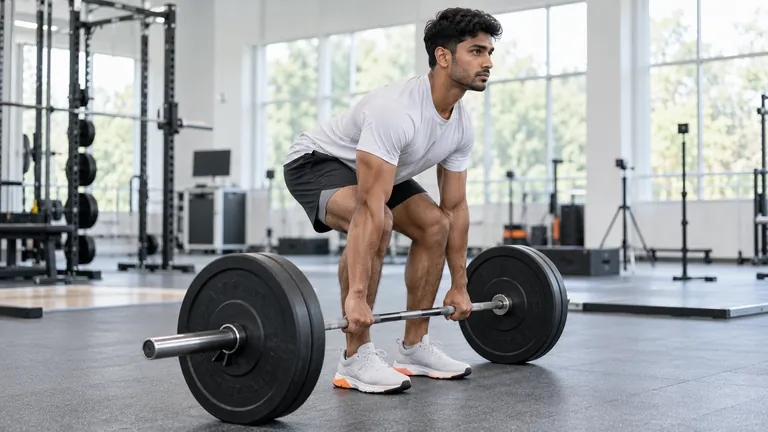
Stand with the bar over mid-foot, hinge at the hips to grip it just outside the knees, then pull the slack out of the bar and brace. Push the floor away while the bar stays close to the legs, and stand tall by extending the hips and knees together. Lower with control.
 Cibiraj Sathishkumar · Accredited Exercise and Sports Scientist, Founder of EvoQuest
Updated · 8 min read
Key takeaways
- The deadlift is a hip hinge: the hips go back, the shins stay near vertical and the spine stays neutral.
- Keep the bar close, over mid-foot, and "pull the slack out" before the plate leaves the floor.
- Conventional and sumo both work; sumo tends to load the quads more and keep the trunk more upright.
- Learn with a kettlebell or trap-bar deadlift and Romanian deadlifts before heavy barbell pulls.
- Progress load slowly and stop sets when the back begins to round.
On this page
- Why the deadlift belongs in athlete training
- Muscles worked and the biomechanics
- Step-by-step: the conventional deadlift
- Conventional, sumo, Romanian and trap bar: which one?
- Common deadlift mistakes and fixes
- Deadlift progressions from beginner to athlete
- Warm-up, belt and grip questions
- Sets, reps and loading by goal
- What the science says
- Deadlifts for sprinters, fast bowlers and team sports
- How to test your hinge without a barbell
- Deadlift safety and youth considerations
- How EvoQuest measures a deadlift
- FAQs
Why the deadlift belongs in athlete training
Picking a weight up off the floor is one of the oldest human movements, and the deadlift turns it into a measurable strength test. It trains the glutes, hamstrings, back and grip together, and it carries over to sprinting, jumping, throwing and tackling.
Search volume for "deadlift form" and "how to deadlift" is high across India because many people start lifting in a commercial gym with no coaching. A deadlift done well builds powerful hips and a strong back. Done badly, with a rounded spine and a bar drifting away from the legs, it is an easy way to feel sore for the wrong reasons.
We want you to learn the hinge first. Once you can hinge, you can deadlift in different styles, and the Romanian and trap-bar versions teach the pattern with lower risk.
Muscles worked and the biomechanics
The deadlift is a hip-dominant pull. The bar starts on the floor and the lifter stands up, extending hip and knee together with the trunk braced.
Style changes the demand. Escamilla and colleagues compared sumo and conventional deadlifts in 13 collegiate football players using a 12-repetition maximum. Quadriceps activity (vastus medialis and lateralis) and tibialis anterior activity were greater in the sumo deadlift, while medial gastrocnemius activity was greater in the conventional lift. Lee and colleagues compared conventional and Romanian deadlifts and found higher gluteus maximus and rectus femoris activity in the conventional deadlift.
Sumo lifters generally show a more upright trunk at the start, which some researchers suggest lowers lumbar stress, but that is a reasonable inference and not a measured proof of lower risk. Choose the style that fits your body and your goal.
- 1
Set the bar and stance
Stand with feet hip width apart and the bar over mid-foot, close to the shins.
- 2
Hinge and grip
Push the hips back, bend down and grip the bar just outside the knees with straight arms.
- 3
Pull the slack and brace
Bring the chest up, tighten the lats until the plates click and take a deep breath into the belly.
- 4
Push the floor away
Drive through the feet, keeping the bar against the legs, with the hips and shoulders rising together.
- 5
Stand tall and lower
Finish with the glutes squeezed and ribs stacked, then return the bar by hinging back first, then bending the knees.
Step-by-step: the conventional deadlift
- Stand with feet hip width apart and the bar over mid-foot, about 2 to 3 centimetres from the shins.
- Push the hips back and bend down to grip the bar just outside the knees. Use a double overhand grip, or mixed or hook if you need it.
- Bring the shins forward until they touch the bar. The shoulders should sit slightly in front of the bar and the arms stay straight.
- Pull the slack out of the bar: lightly lift until you feel the plates click and your lats tighten, as if bending the bar around your shins.
- Take a big breath into the belly and brace. Keep the neck in line with the spine.
- Push the floor away. Let the bar slide up the legs, hips and shoulders rising together, until you are standing tall.
- Squeeze the glutes at the top without leaning back. Lower with the hips going back first, then the knees, keeping the bar close all the way down.
Conventional, sumo, Romanian and trap bar: which one?
Try each style. The best deadlift is the one where your spine stays neutral, the bar stays close and you can repeat clean reps.
Common deadlift mistakes and fixes
Deadlift progressions from beginner to athlete
Strength coaches often use velocity tracking to decide when to add load. Bar speed that drops sharply across a set signals fatigue, which is one reason to see velocity-based training in action. If you are a cricketer or sprinter, the trap bar or Romanian version may fit your season better than a heavy conventional single.
Warm-up, belt and grip questions
Warm up with five minutes of easy movement, then do hip hinge drills and two or three ramp-up sets: a light set of 5, a moderate set of 3, and a heavier set of 2 before your working weight. Warm-up sets rehearse the setup as well as the load.
A belt can help you brace harder at heavy loads. In the same Escamilla study that compared styles, belt use was one of the conditions tested. Think of a belt as a tool for loads that already feel solid, not a way to fix poor technique.
Grip often fails before the back does. Double overhand is good for lighter sets. Mixed grip (one hand over, one under) helps heavy sets but can load the biceps unevenly, so alternate sides. Hook grip is used by lifters who can tolerate it. Chalk helps a lot in Coimbatore's heat and humidity, when sweaty palms slip.
Footwear matters. Flat, firm-soled shoes or bare feet give a stable floor. Soft running shoes absorb force and make the bar feel uncertain.
Sets, reps and loading by goal
Heavy pulls fatigue the back and hamstrings for days, so many programmes limit heavy floor pulls to one or two sessions a week and use Romanian or trap-bar variations on other days. Young athletes should focus on technique, using kettlebells or light bars under a coach. The NSCA long-term athletic development statement supports gradual progression.
What the science says
Research on the deadlift is mostly small EMG and kinematic studies, so conclusions need caution. Escamilla and colleagues, in a 2002 EMG study of 13 collegiate football players, found that the sumo deadlift produced greater activity in the vastus medialis, vastus lateralis and tibialis anterior, while the conventional lift produced greater activity in the medial gastrocnemius. The same study compared belt and no-belt lifting.
In another EMG and kinetic comparison, Lee and colleagues reported that the conventional deadlift gave higher gluteus maximus and rectus femoris activity than the Romanian deadlift, which is reasonable because the conventional pull has a bigger knee bend. Reviews of deadlift kinematics report that sumo and conventional styles differ in joint angles and trunk posture, but lumbar load itself is rarely measured directly.
Deadlifts for sprinters, fast bowlers and team sports
Sprinters use deadlift strength to build the hip extension that drives acceleration. Fast bowlers and throwers use it to build a strong posterior chain that handles braking and landing forces. Football, hockey and kabaddi athletes use trap-bar deadlifts to build force quickly without needing a deep squat.
The deadlift also has a ceiling for athletes who are not powerlifters. Past a point, extra weight on the bar makes less sense than jump training, sprint work and single-leg strength. A coach who understands your sport can place the deadlift in context.
In heat, plan hard pulls for early morning or evening sessions when possible, and keep water nearby. Dehydration reduces strength and attention, which is when form slips.
How to test your hinge without a barbell
Stand with your back against a wall, feet about 15 cm away, and push the hips back to touch the wall while the knees stay soft. If you can do that and your back stays flat, try the dowel drill: hold a stick along the spine with the back of the head, upper back and tailbone touching it, then hinge until you feel a hamstring stretch.
If you lose contact with the stick, you are rounding or arching. Reset and use a shallower range. You can also film yourself from the side with a kettlebell deadlift and check that the back angle is steady from the floor to standing.
Once the hinge feels easy, load it gradually. Increases of 2.5 to 5 kg in the barbell are a sensible start for most adults.
Deadlift safety and youth considerations
Stop the set if the lower back rounds, if you feel sharp pain or if bar speed collapses compared with earlier reps. Avoid max-effort attempts when tired or sleep-deprived. A pre-existing back problem, herniated disc or recent surgery needs medical clearance and a physio-led plan.
For young athletes, kettlebell and trap-bar deadlifts with light loads are an effective way to learn the pattern. The NSCA long-term athletic development position supports supervised resistance training, with technique before intensity. Growth-related issues such as heel or knee pain in a growing child should be checked by a doctor.
How EvoQuest measures a deadlift
A one-rep max says how heavy, not how well. At EvoQuest Sports Science in Coimbatore, force plates under the lifter show how force builds from the floor and whether the left and right legs share the load. Velocity-based training tools record bar speed in every rep, so a coach can see when fatigue is cutting speed and when a load is too slow for power training. Motion analysis shows spinal position, bar path and hip height.
Those numbers help set loads, compare left and right, and track progress between phases. See our testing and technology and strength and conditioning.
If the deadlift causes sharp back, hip or hamstring pain, stop and see a doctor or physio. We work with athletes returning to performance after physio clearance.
Want a coach to check your hinge? Book a free 20-minute call and tell us your sport and training history.
Frequently asked questions
How do I deadlift with good form?
Set the bar over mid-foot, hinge to grip just outside the knees, pull the slack out and brace. Push the floor away with the bar close to the legs, stand tall with the glutes squeezed, then lower by sending the hips back first. Stop if the back rounds.
Is conventional or sumo deadlift better?
Neither is universally better. EMG research shows sumo uses the quadriceps and tibialis anterior more, and conventional uses the calves more. Choose the style that lets you keep a neutral spine and a close bar path for your body shape and goals.
Is the deadlift bad for the back?
Done with a neutral spine, controlled load and progressive overload, the deadlift is widely used to build back and hip strength. Rounding under heavy load, jerking the bar or increasing weight too fast raises risk. Back pain that lingers needs a doctor or physio.
What is a Romanian deadlift?
A Romanian deadlift starts standing with a bar at the thighs. You push the hips back, keep the knees soft and slide the bar down the legs until you feel a hamstring stretch, then stand up. It teaches the hip hinge and loads the hamstrings and glutes.
How often should I deadlift?
Many programmes use one or two heavy deadlift sessions per week, with lighter hinge work such as Romanian deadlifts on other days. How often you can recover depends on training age, sport and sleep. Start with fewer sessions and add only if technique and energy stay good.
Can teenagers deadlift?
Supervised young athletes can learn the hinge with kettlebells and light bars. Position statements from the NSCA support appropriately coached resistance training in youth. Focus on technique and low loads first, and avoid max attempts until the pattern is stable.
This article is general education. Train within your current ability and get coaching if you are unsure about technique.
References
- An electromyographic analysis of sumo and conventional style deadlifts Medicine and Science in Sports and Exercise (Escamilla et al., 2002), PubMed
- An electromyographic and kinetic comparison of conventional and Romanian deadlifts Journal of Exercise Science and Fitness (Lee et al., 2018), PubMed
- National Strength and Conditioning Association position statement on long-term athletic development Journal of Strength and Conditioning Research (PubMed)
- Effects of velocity-based training on strength and power in elite athletes: a systematic review International Journal of Environmental Research and Public Health (PMC)
Cibiraj studied Exercise and Sports Science at Deakin University in Australia and worked as a strength and conditioning coach for cricket and football clubs in Melbourne before founding EvoQuest in Coimbatore. He runs the performance assessments and writes every diagnostics report, so the person who measures you is the one who explains the numbers.