
How to do kettlebell swing properly: Form Guide
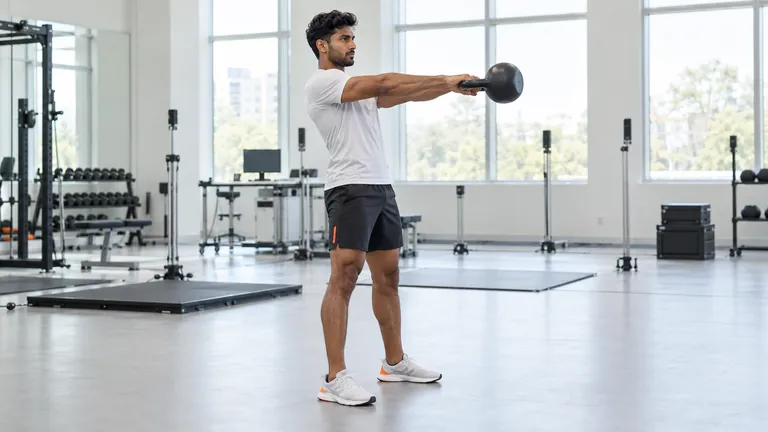
Hike the kettlebell back between your legs, then snap your hips forward so the bell floats to chest height. Your arms guide it, your hips power it. Keep a flat back, let the bell fall back toward the groin and hinge again without squatting.
 Cibiraj Sathishkumar · Accredited Exercise and Sports Scientist, Founder of EvoQuest
Updated · 3 min read
Key takeaways
- Hike the kettlebell back between your legs, then snap your hips forward so the bell floats to chest height.
- Cue: Hike it back
- Cue: Hips snap, arms guide
- Most common mistake: Turning the swing into a squat
On this page
Muscles the kettlebell swing works
| Muscle | Role in the kettlebell swing |
|---|---|
| glutes | Primary mover |
| hamstrings | Primary mover |
| erector spinae | Assists or stabilises |
| lats | Assists or stabilises |
| core | Assists or stabilises |
| forearms | Assists or stabilises |
Set-up
- Place the kettlebell about 30 cm in front of you.
- Stand slightly wider than shoulder width with toes turned out a little.
- Choose a bell you can control for all reps with a flat back.
How to do the kettlebell swing, step by step
- 1
Step 1
Hinge at the hips, push them back and grip the handle with both hands.
- 2
Step 2
Tilt the bell toward you and hike it back high between your thighs.
- 3
Step 3
Drive hips forward hard and stand tall.
- 4
Step 4
Let the bell float to chest height with straight arms.
- 5
Step 5
Let it fall, hinge back and guide it into the next hike.
- 6
Step 6
At the end of the set, park the bell by hinging down in control.
Coaching cues that fix most reps
- Hike it back
- Hips snap, arms guide
- Stand tall at the top
- Hinge, do not squat
Breathe in at the top as the bell floats, brace as it drops, and exhale sharply as the hips snap forward.
Common mistakes and fixes
| Mistake | Why it matters | Fix |
|---|---|---|
| Turning the swing into a squat | A deep knee bend loses hip drive and loads the quads instead of the glutes. | Push the hips back and keep the shins nearly vertical. |
| Lifting with the arms | Arm pulling shortens the swing and strains the shoulders. | Keep arms loose and let hip speed carry the bell. |
| Rounding the back at the bottom | Spinal flexion under speed stresses the lower back. | Brace your core, chest proud, and hinge from the hips. |
| Leaning back at the top | Hyperextension irritates the lower back and wastes energy. | Finish with ribs stacked over the pelvis and glutes squeezed. |
| Letting the bell drop away from the body | A bell that swings too low pulls you forward and out of position. | Hike it high into the hips and keep it close. |
Make it easier or harder
| Level | Exercise |
|---|---|
| Easier | Deadlift with the bell on the floor |
| Easier | Hip hinge with a wall tap behind you |
| Easier | Kettlebell hike and stop |
| Target | kettlebell swing |
| Harder | Heavier kettlebell |
| Harder | One-arm swing |
| Harder | Swing ladder with a timed finisher |
Sets and reps by goal
| Goal | Sets, reps or time |
|---|---|
| Beginner | 3 sets of 8 to 12 reps with a light bell |
| Athlete | 4 to 6 sets of 10 to 15 reps, or timed 30 second rounds |
| Strength or power focus | 5 to 8 sets of 5 to 8 reps with a heavy bell and long rest |
Swings are hard on the grip and posterior chain, so allow a day or two between heavy sessions. For conditioning the same movement can be repeated more often if volume is small.
How it carries over to sport
- Cricket: Hip power for fast bowling and big hitting.
- Sprints: Explosive hip extension that feeds the push-off.
- Wrestling and kabaddi: Posterior chain strength and conditioning for hard efforts.
- Football: Strength endurance for sprinting and tackling.
Safety and who should modify it
See a doctor or physio if you have acute back pain, a disc problem or shoulder pain. Learn the hinge with a coach first. Do not progress the load until the back stays flat for every rep.
How EvoQuest measures it
VBT sensors suit barbells better than kettlebells, but a force plate under a swing can show peak hip drive and symmetry. Heart rate and lactate can show how a swing set taxes your conditioning.
In the assessment we film and measure this movement, compare left and right sides, and turn the result into the next block of training.
Frequently asked questions
Is a kettlebell swing a squat?
No. A swing is a hip hinge, not a squat. The knees bend a little, but the power comes from pushing the hips back and snapping them forward. If your thighs are doing most of the work and the bell stays low, the swing is turning into a squat.
What weight should I start with?
Pick a bell you can hinge with while keeping a flat back for every rep. Many beginners start light and move up once the movement looks clean on video. If the bell pulls you forward or your back rounds, the weight is too heavy for now.
Why does my lower back hurt after swings?
Usually the hinge is turning into a back lean, or the bell is pulling you over at the bottom. Drop the weight, brace harder, and finish each rep by squeezing the glutes instead of leaning back. See a physio if the pain lingers or spreads down the leg.
Are kettlebell swings good for cardio?
Yes. Repeated swings in timed rounds raise heart rate quickly and build strength endurance in the hips and back. Keep form clean as you tire, and stop the set when your back starts to round, because a sloppy swing adds risk without adding benefit.
This article is general education, not medical advice. If you have pain, a recent injury or a medical condition, see a doctor or physiotherapist before training.
Cibiraj studied Exercise and Sports Science at Deakin University in Australia and worked as a strength and conditioning coach for cricket and football clubs in Melbourne before founding EvoQuest in Coimbatore. He runs the performance assessments and writes every diagnostics report, so the person who measures you is the one who explains the numbers.