
Goblet squat muscles worked: a phase by phase guide
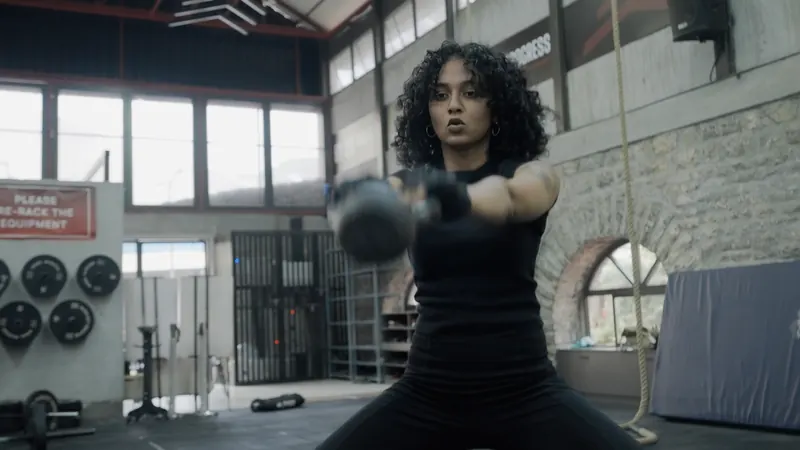
The goblet squat works the quadriceps and gluteus maximus as prime movers, with the adductors, core, upper back and arms helping. The weight held at the chest adds demand on the trunk and the muscles holding the weight, while acting as a counterbalance that lets the hips sit deeper.
 Cibiraj Sathishkumar · Accredited Exercise and Sports Scientist, Founder of EvoQuest
Updated · 4 min read
Key takeaways
- Quadriceps and glutes are the prime movers; adductors help in the bottom position.
- The trunk and upper back brace against the weight pulling forward.
- The biceps and forearms hold the weight but are not the target.
- Muscle roles shift between lowering, the bottom and standing up.
- Heels, depth and tempo change the work more than the type of weight.
On this page
Prime movers and helpers
For this lift the prime movers are the quadriceps and the gluteus maximus. Core, adductors and upper back play supporting roles. The weight is held in front, so the trunk muscles must resist the pull that wants to tip the chest forward.
The arms hold the bell but do not move it. The biceps and forearms work isometrically, which is why grip and arm fatigue can show up before the legs tire in higher-rep sets.
The adductors on the inner thigh join in at the bottom of the squat, where the knees are wide and the hips are flexed. Calves and the muscles around the ankle keep the shin steady over the foot. These small muscles rarely get credit, yet limited ankle range is one of the most common reasons people cannot sit deep.
Muscle roles through one repetition
Roles change as the hips go down and back up. The table gives a plain-language map. Exact muscle activity depends on depth, load and body shape.
The lowering phase is the one most people rush. Slowing it for three seconds gives the quadriceps and glutes more work per repetition and shows where position slips. If you can only control the lowering at light weights, that is useful information about where strength stands today.
Why the weight in front changes the squat
Holding a weight at the chest moves the combined centre of mass forward. To stay balanced, you sit your hips lower and keep your chest tall. That helps many people reach depth without the heels lifting or the back rounding.
The same position raises the demand on the muscles in front of the trunk and in the upper back. A scoping review of the deep squat and knee structures and a study of load across squat depth both note that depth changes joint loading, so increase range gradually while the position settles.
Foot position fits the same picture. Toes turned out slightly give the hips room to drop between the knees, and the knees track over the toes as you sink. Find the stance that lets you reach depth with heels down, then keep it for the whole set.
How depth, heels and tempo shift the work
A deeper squat asks more of the glutes and adductors. A shallow squat leans more on the quadriceps. Raising the heels slightly on a plate shifts the knees forward and increases quadriceps demand, which some people use as a variation.
A slow three-second lowering phase raises time under tension across the legs and trunk. A pause in the bottom removes elastic rebound so that the muscles produce force from rest. The kettlebell and the dumbbell load the same muscles, although a kettlebell's handle position can feel more comfortable against the chest.
Myths about the goblet squat
One myth says it is only a beginner exercise. Beginners use it widely, and trained athletes still use it for warm-ups, pattern practice and lighter days. Another myth says the arms grow from it. They hold the weight, but the load on them is small compared with curls and rows.
A further myth says the goblet squat trains only the quadriceps. The glutes and adductors contribute strongly in the bottom position. For heavy leg strength it has a ceiling, and the NSCA youth resistance training statement frames it as a sensible way to build movement skill before heavier bars.
One more worry comes up often: that deep squats are bad for the knees. The scoping review of the deep squat and knee structures looks at the evidence on this question and reports on joint loading, so it is wise to build depth over weeks and stop if pain appears. The decision about depth should be made for the individual with a coach.
What a lab can add
A muscle list does not show whether both legs share the load. EvoQuest uses force plates to compare left and right push, and motion analysis to check depth and torso angle. These checks are helpful when an athlete reports one side feeling stronger. Pain, though, needs a doctor or physio. For full technique, see how to do the goblet squat properly.
Frequently asked questions
Does the goblet squat work the glutes?
Yes. The gluteus maximus works alongside the quadriceps as a prime mover, especially as you reach depth and stand up from the bottom. A deeper squat with a controlled lowering phase raises glute involvement. Heels flat and knees tracking over the toes help both muscles share the load.
Why do my arms and upper back tire?
The arms hold the weight at your chest for the whole set, and the upper back works to keep the chest tall. These muscles can tire before your legs, particularly in higher-rep sets. Take short breaks between sets, or pick a weight you can hold comfortably for the planned reps.
Is the goblet squat good for the core?
The trunk muscles resist the forward pull of the weight, so the core works throughout the lift. This is bracing work, not crunch-style work. The goblet squat builds trunk stiffness that carries into other lifts, and a coach can add pauses to challenge it further.
Does a kettlebell work different muscles than a dumbbell?
The muscles are the same. A kettlebell often sits comfortably against the chest with the handle held at both sides, while a dumbbell is gripped at one end. Choose the one that lets you hold a stable position with an upright torso.
This article is general education. Train within your current ability and get coaching if you are unsure about technique.
References
- Analysis of the load on the knee joint and vertebral column with changes in squatting depth and weight load Sports Medicine
- Impact of the deep squat on articular knee joint structures: a scoping review Frontiers in Sports and Active Living, 2024
- Youth resistance training: updated position statement paper from the National Strength and Conditioning Association Journal of Strength and Conditioning Research, 2009
Cibiraj studied Exercise and Sports Science at Deakin University in Australia and worked as a strength and conditioning coach for cricket and football clubs in Melbourne before founding EvoQuest in Coimbatore. He runs the performance assessments and writes every diagnostics report, so the person who measures you is the one who explains the numbers.