
What is sports science?
Sports science is the study of how the body and mind respond to exercise, training and competition, used to improve performance and reduce injury. It combines physiology, biomechanics, strength and conditioning, nutrition, psychology and data analysis. It supports coaches with measurement and does not replace medical care.
 Cibiraj Sathishkumar · Accredited Exercise and Sports Scientist, Founder of EvoQuest
Updated · 8 min read
Key takeaways
- Sports science applies physiology, biomechanics, nutrition, psychology and data to athletic performance.
- It differs from general fitness by aiming at a specific sporting outcome and checking progress with tests.
- Managing training load and recovery is one of its biggest contributions to injury prevention.
- Medical diagnosis and treatment stay with doctors and physiotherapists, with performance testing after clearance.
- School athletes and parents in India can use the same ideas at a simpler level.
On this page
- What sports science is
- The main branches
- How sports science differs from fitness training
- The tools of a sports science lab
- Load and recovery: the part most people skip
- How sports science helps with injury risk
- How a sports science programme is built
- Common myths about sports science
- Who uses sports science in India
- Can a normal athlete benefit?
- FAQs
What sports science is
Sports science is the study of how the human body and mind respond to exercise, training and competition, and the use of that knowledge to improve performance and reduce injury. It borrows from physiology, biomechanics, psychology, nutrition and data analysis.
A simple way to picture it: the coach decides what to train, and sports science helps answer how much, how hard, how often to recover and how to check that it worked. The athlete still has to do the work. Science makes the work better aimed.
Searches for sports science in India have grown over the past few years, and Tamil Nadu shows one of the highest shares of interest in Google Trends data. Parents, school coaches and young athletes are asking what the field actually involves, so this article walks through it in plain language.
The main branches
Sports science is not one job. It is a group of related specialities, and a good programme draws on several of them.
The last row deserves a note. Medical care sits next to sports science, and the two work together, but they are different jobs. A performance lab such as EvoQuest does not diagnose or treat injuries. It helps athletes return to full performance after a doctor or physiotherapist has cleared them. To see how the training branch differs from general gym coaching, read S&C coach vs personal trainer.
How sports science differs from fitness training
General fitness aims at health: a stronger body, a healthier heart, a lighter weight. Sports science aims at a specific sporting outcome: a faster 30 m sprint, a more durable fast bowler, a better repeated-sprint ability in football.
That changes the method. A general programme can follow a popular template. A sports science approach starts with the demands of the sport, measures the athlete against those demands, builds a plan around the gaps and tests again. A kabaddi raider needs explosive hip power and quick direction changes. A marathon runner needs aerobic efficiency. The gym equipment may look similar, but the programmes are different.
The World Health Organization recommends an average of 60 minutes per day of moderate to vigorous physical activity for children and adolescents, along with muscle-strengthening activity. That is the health floor. Athletes train above it, and sports science helps manage the extra load safely.
The tools of a sports science lab
Most of the headline equipment exists to measure something that the eye cannot judge reliably.
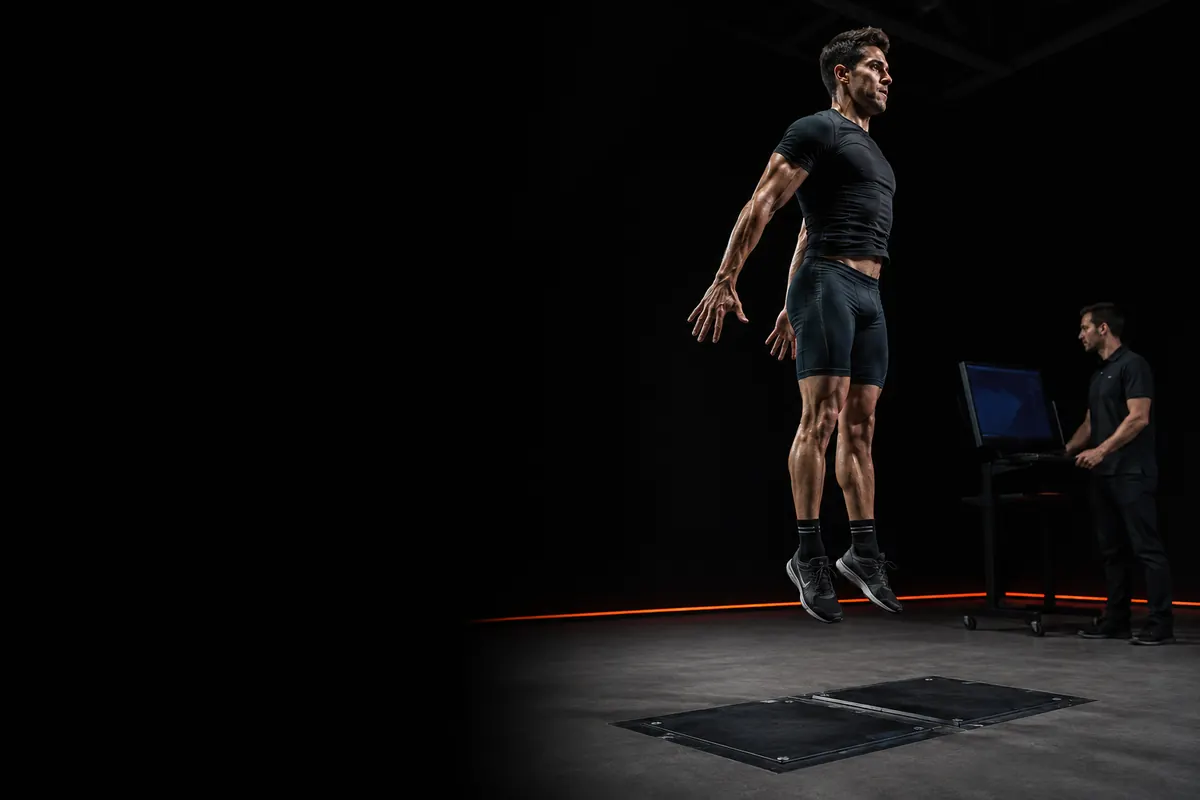
- Force plates record how hard and how fast an athlete pushes into the ground during a jump, landing or isometric pull. They also show left and right leg differences.
- Velocity-based training sensors measure how fast a barbell moves. Bar speed tells a coach how hard a set really was and when fatigue is building.
- Timing gates record sprint and agility times to hundredths of a second, removing the error of hand timing.
- GPS and heart rate monitors track distance, high-speed running, accelerations and internal load across sessions.
- Lactate analysers and gas analysis help describe aerobic and anaerobic fitness for endurance and repeated-effort sports.
- Dynamometers measure muscle force in a single joint action, such as grip or knee extension.
- Motion analysis uses video or sensors to study technique, for example how a player lands from a jump.
EvoQuest Sports Science in Ramanathapuram, Coimbatore, runs a three-hour performance assessment that combines these tools. See testing and technology for what each device does, and what is sports performance testing for the testing logic.
Load and recovery: the part most people skip
A large share of sports science is about balancing stress and recovery. The International Olympic Committee consensus statement on load in sport and risk of injury describes poor load management, including rapid changes in training and competition load, as a major injury risk factor.
This is easy to see in everyday sport. A school cricketer who bowls 3 overs a day in the nets and then bowls 20 in a tournament has changed the load abruptly. A runner who triples weekly distance after exams is in the same position. The body adapts to gradual increases and struggles with spikes.
Tools help here, but simple methods work too. Rate each session on a 1 to 10 scale for effort (session RPE), multiply by minutes, and compare week to week. A big jump in one week is a flag to ease off. The same record also shows when an athlete is ready to push harder.
How sports science helps with injury risk
Injury cannot be removed from sport, but some risk factors can be reduced. Sports science does this through load management, strength training, movement screening and return-to-play testing.
Research supports structured warm-up programmes. A systematic review of six randomised trials with 6,344 football players found that the FIFA 11+ programme was associated with about 30 percent fewer injuries, though the trials varied a lot and the review urged careful reading. Strength work also protects tendons and muscles when the dose is right.
Where an injury has already happened, the process belongs first to the doctor and physiotherapist. Once cleared, a performance team can test strength, hop and jump symmetry and sprint ability so the return is based on data and not only on the calendar. The 2016 Bern consensus statement frames return to sport as a continuum and a risk management decision, and notes that the evidence for any single test is limited, which is why several measures are used together.
How a sports science programme is built
The cycle is the same in a national team and a school academy: assess, plan, train, monitor, reassess. The details change, the logic does not.
- Assess. Collect a history, measure key qualities and note the demands of the sport.
- Plan. Pick one or two priorities and set a target that can be checked, such as a jump height or a sprint time.
- Train. Use exercises and loads that match the priority. Strength, power, speed and conditioning work each have well-known dose ranges in the research, for example 2 to 4 sets of 3 to 8 repetitions for strength and power exercises.
- Monitor. Track how the athlete responds: bar speed, session effort rating, sleep, soreness, resting heart rate.
- Reassess. Repeat the tests under the same conditions and compare. Adjust the plan.
Notice that the cycle does not need exotic equipment to start. A stopwatch, a tape measure and a notebook can run a basic version. What the lab adds is precision and the ability to see why a result changed.
Common myths about sports science
Several beliefs keep athletes from using the field well. Here are the ones coaches meet most.
- Myth: it is only for professionals. In practice school and club athletes often gain the most from a first assessment, because obvious gaps are still unaddressed.
- Myth: more data always means better coaching. Data helps only when it changes a decision. A coach tracking twenty numbers and acting on none is no better off than one tracking three and acting on all of them.
- Myth: the machine decides. Devices give measurements. People interpret them, and a number without context about the sport, the age and the athlete's week can mislead.
- Myth: it replaces the coach. Skill, tactics and motivation stay with the coach. Science supplies the physical side of the picture.
- Myth: static stretching before every session is the safest warm-up. Network meta-analysis findings suggest dynamic stretching, done for around 7 to 10 minutes, improves jump and sprint results, while static stretching slightly slows sprint time. Static work is still useful for flexibility on its own time. See how to warm up before sports.
Treat any new product or claim with the same curiosity. Ask what was measured, in whom, and whether the effect was big enough to matter on the field.
Who uses sports science in India
Government and academy systems are growing. The Khelo India fitness assessment for school children, run through the Sports Authority of India, tests a 50 m sprint, 600 m run, sit and reach, curl-ups and push-ups for ages 9 to 18. Private academies in cricket, badminton, football and athletics increasingly ask for measured data. Universities have added sports science degrees, and more sports medicine clinics offer testing.
For Tamil Nadu families, the practical question is access: where can a 14-year-old state-level shuttler or a district cricketer get a proper assessment close to home? Options include university labs, hospital sports medicine departments and private performance labs. When you compare them, ask what is measured, who interprets the result and how the report links to training. The post on how to choose a sports science lab lists the questions.
Can a normal athlete benefit?
Yes, and the benefit is often larger for someone who has never been measured, because the first assessment usually finds one or two obvious gaps. A school footballer may discover weak single-leg strength. A weekend runner may learn that their easy runs are too fast and their hard runs too slow.
Sports science also helps parents. It gives a factual basis for decisions such as how much extra coaching a child needs, whether a niggle needs a doctor and whether a sport specialisation decision can wait. The NSCA long-term athletic development statement argues for broad athletic skill building in youth before early narrow specialisation.
If you are not sure where you fit, book the free 20-minute call. Describe the sport, age and goal, and ask what a first step would look like. WhatsApp is +91 93440 48834.
Frequently asked questions
What is sports science in simple words?
Sports science is the use of physiology, biomechanics, nutrition, psychology and data to improve athletic performance and lower injury risk. It measures how an athlete responds to training and uses that information to adjust the plan. It supports coaches and does not replace them.
What does a sports scientist do?
A sports scientist tests athletes, monitors training load, analyses movement and data, and advises coaches on how to adjust programmes. Some focus on strength and conditioning, others on physiology or performance analysis. They do not diagnose or treat injuries; that is the work of doctors and physiotherapists.
Is sports science only for elite athletes?
No. School, club and recreational athletes can use the same ideas at a simpler level. A first assessment often shows clear gaps in strength, speed or recovery that are easy to improve. Elite teams just collect data more often and with more equipment.
What is the difference between sports science and sports medicine?
Sports medicine diagnoses and treats injury and illness in active people. Sports science studies and improves performance through testing, training design, nutrition and load monitoring. The two overlap in return-to-play decisions, where medical clearance comes first and performance testing follows.
Can I study sports science in India?
Yes. Several Indian universities and institutes offer degrees and diplomas in sports science, sports medicine or exercise physiology, and the number of programmes has grown in recent years. Check the course content, lab access and practical placements before enrolling.
How do I know if I need a sports science assessment?
Consider one if you are training seriously and have plateaued, if you are returning to sport after clearance from a doctor or physio, or if you want a baseline before a big season. A short call with a performance lab can help you decide.
This article is general education. Train within your current ability and get coaching if you are unsure about technique.
References
- World Health Organization 2020 guidelines on physical activity and sedentary behaviour British Journal of Sports Medicine, 2020
- How much is too much? (Part 1) International Olympic Committee consensus statement on load in sport and risk of injury British Journal of Sports Medicine, 2016
- The FIFA 11+ injury prevention program for soccer players: a systematic review BMC Sports Science, Medicine and Rehabilitation, 2017
- 2016 Consensus statement on return to sport from the First World Congress in Sports Physical Therapy, Bern British Journal of Sports Medicine, 2016
- National Strength and Conditioning Association position statement on long-term athletic development NSCA / Journal of Strength and Conditioning Research, 2016
- Khelo India Fitness Assessment: administration manual Sports Authority of India
- A systematic review and net meta-analysis of the effects of different warm-up methods on the acute effects of lower limb explosive strength BMC Sports Science, Medicine and Rehabilitation, 2023
Cibiraj studied Exercise and Sports Science at Deakin University in Australia and worked as a strength and conditioning coach for cricket and football clubs in Melbourne before founding EvoQuest in Coimbatore. He runs the performance assessments and writes every diagnostics report, so the person who measures you is the one who explains the numbers.