
Throwball warm up: a 12-minute routine for shoulders, wrists and quick footwork
A throwball warm up takes about 12 minutes: a light jog and shuffle, shoulder, wrist and finger mobility, short throw and catch drills with a partner, then net play with jumps and landings. The game relies on powerful throws and secure catches, so the throwing arm and the landing legs are prepared together.
 Cibiraj Sathishkumar · Accredited Exercise and Sports Scientist, Founder of EvoQuest
Updated · 4 min read
Key takeaways
- Throwball is a net game of strong throws and firm catches, so shoulders, wrists and fingers lead the warm-up.
- Jumping to catch means landing practice belongs in the routine.
- Throws start short and soft, then lengthen and speed up.
- Partner drills double as skill work.
- Hot indoor halls and slippery floors need extra care.
On this page
Why the throwing arm and the legs both need attention
Throwball players stand on a court divided by a net, throw the ball over with one hand and force the opponent to drop the catch. The throw is hard and flat, so the shoulder, elbow and wrist generate and absorb speed. The catch lands in the fingers and palm. Meanwhile, players move sideways, jump to catch high balls and land.
That adds up to a sport where fingers, wrists, shoulders and ankles all matter. The routine is short, but each stage is chosen with one body part in mind.
Throwball-specific injury research is sparse. We rely on reviews of shoulder injuries in overhead sports and of ankle injury prevention, and we label that clearly.
The 12-minute routine
Begin with a light jog around the court, followed by side shuffles along the net and skipping. Stop when you feel warm and are breathing a little faster, about three minutes.
For mobility, circle the arms forward and back, rotate the trunk with arms outstretched, circle the wrists and gently spread and close the fingers. A cross-body shoulder swing and a doorway chest opener, held briefly, loosen the front of the shoulder.
Then bring in the ball. Start with underhand tosses to a partner five metres away. Step back as the throws loosen, add the overhand throw and finish with the full throw used in the game.
- 1
Raise
Light jog, side shuffle and skip for 3 minutes.
- 2
Mobilise
Shoulder circles, trunk twists, wrist and finger work for 3 minutes.
- 3
Throw and catch
Short, medium, then long throws with a partner for 3 minutes.
- 4
Landings
Small jumps to catch and stick the landing for 2 minutes.
- 5
Net play
A few quick throws over the net before the game.
Throw and catch ladder
A ladder means moving through distances and speeds. Spend 30 seconds at each: short and soft, short and firm, medium and firm, long and firm. Catch with both hands, fingers spread and elbows soft to absorb the ball.
Add a variation where the partner throws slightly to the side, so you must reach. Add another where the catcher takes a step before catching, to build the timing of the game.
Keep the first throws easy. Overhead sports reviews describe throwing as heavy shoulder loading, and a sudden hard throw from cold is a common way to strain the shoulder. The Thrower's Ten shoulder programme has been studied in overhead athletes and is an example of a structured shoulder routine for off-court work.
Landings and footwork
Jumping to catch means landing on one or both feet, often with a twist. Soft landings protect the ankle and knee. Practise by hopping lightly and sticking the landing for two seconds, knees over toes and chest tall.
Add lateral shuffles and quick steps toward the net, and a few jumps to catch a ball tossed above the head. Check the floor is dry. Sweat and dust on indoor courts make landings slippery.
Balance training has been linked with fewer ankle sprains in a meta-analysis of athletes, so a few single-leg balance holds with the ball passed hand to hand are worth including.
Match day and school tournaments
Before a match, run the 12-minute routine and finish with a few quick exchanges across the net at full speed. During a tournament day with several games, repeat a short 4-minute top-up between matches: shoulder circles, a handful of throws and some landings.
School teams often play in warm, crowded halls. Drink small amounts of water between games and stay out of the sun. Younger players should have simplified drills and shorter throws, and coaches should watch for shoulder or finger pain.
Long static stretches are not needed before the match. A systematic review of acute stretching found that long holds tend to reduce maximal muscle performance, so hold longer stretches afterwards.
What the lab can add
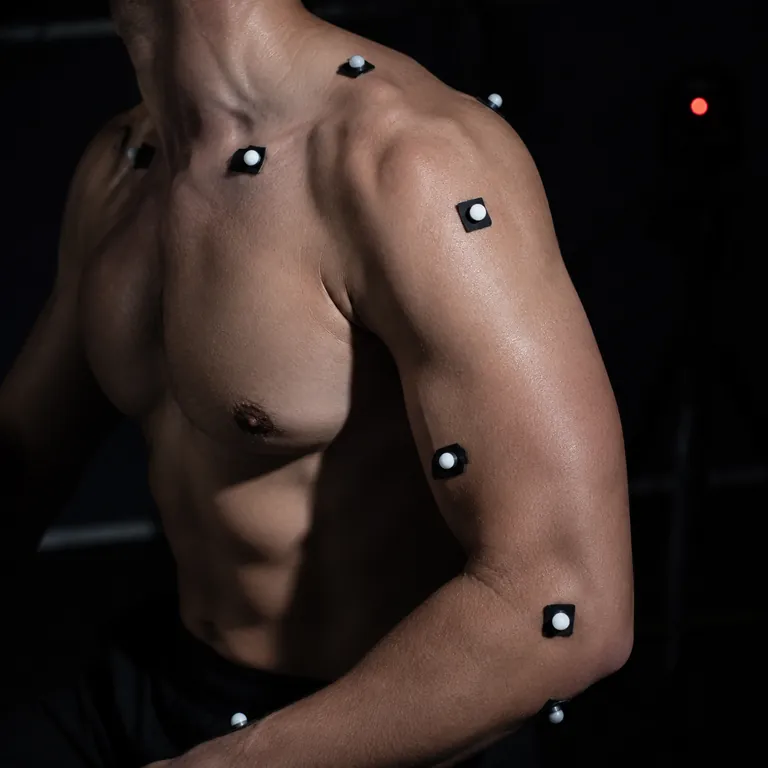
At EvoQuest in Coimbatore, force plates measure jump and landing output, a dynamometer measures shoulder and grip strength and motion analysis shows how the body moves through a throw. A throwball player can use the findings to see whether one side is stronger. A free 20-minute call explains how. Coaches of school teams can also watch for a ball that hurts the fingers on catching, and adjust the feeding speed in the drills so the youngest players build up confidence before the harder throws.
Frequently asked questions
How long should a throwball warm up be?
About 12 minutes before a match, with a 4-minute top-up between games on tournament days.
Why do throwball players warm up their fingers and wrists?
Throws and catches load the fingers and wrists directly. Gentle circles, finger spreads and soft first catches reduce the shock to cold tissue.
Should throwball players stretch before a match?
Use dynamic movement. A systematic review of acute stretching found that long static holds tend to reduce maximal muscle performance, so hold longer stretches after the game.
What if my shoulder hurts when I throw?
Stop hard throws, shorten the distance and tell your coach. Persistent pain should be checked by a physio or doctor.
Can school teams use the same routine?
Yes. Shorten throw distances for younger players and focus on soft landings and secure catches.
This article is general education. Train within your current ability and get coaching if you are unsure about technique.
References
- A systematic review and net meta-analysis of the effects of different warm-up methods on the acute effects of lower limb explosive strength BMC Sports Science, Medicine and Rehabilitation, 2023
- Effect of acute static stretch on maximal muscle performance: a systematic review (Kay and Blazevich) Medicine & Science in Sports & Exercise, 2012
- Risk factors and prevention strategies for shoulder injuries in overhead sports: an updated systematic review Journal of Experimental Orthopaedics
- Rehabilitative and preventive effects of the Thrower's Ten program in overhead athletes: a systematic review Systematic review, 2025
- The effect of bracing and balance training on ankle sprain incidence among athletes: a systematic review with meta-analysis (Bellows and Wong) International Journal of Sports Physical Therapy, 2018
Cibiraj studied Exercise and Sports Science at Deakin University in Australia and worked as a strength and conditioning coach for cricket and football clubs in Melbourne before founding EvoQuest in Coimbatore. He runs the performance assessments and writes every diagnostics report, so the person who measures you is the one who explains the numbers.