
Push press variations: what each changes and how to choose
The main push press variations are the barbell push press, dumbbell push press, single-arm push press, kettlebell push press, push jerk, split jerk and landmine push press. Each changes the load, the balance demand or the catch. Choose by your goal, your equipment and how your shoulders and back feel.
 Cibiraj Sathishkumar · Accredited Exercise and Sports Scientist, Founder of EvoQuest
Updated · 4 min read
Key takeaways
- Dumbbell and single-arm versions expose left and right differences and suit smaller gyms.
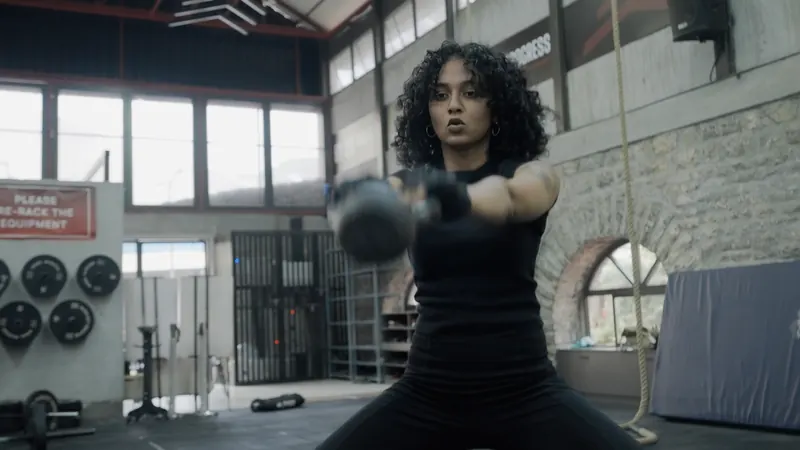
- The kettlebell and landmine versions change the grip and the arm path.
- The push jerk and split jerk add a catch and need more skill and coaching.
- The barbell push press handles the heaviest loads and trains the cleanest timing.
- If any version causes sharp shoulder or back pain, switch and have it checked.
On this page
Seven variations compared
The table compares the options by what they change and who they suit. Loads and demands depend on the individual, so read the notes as general guidance.
Choosing by goal
For maximal power through the whole chain, the barbell push press is the simplest choice because the load can rise in small steps. Haff and Nimphius, in their review of training principles for power, support combining heavy and fast work across a plan. A systematic review of weightlifting-style training, traditional resistance training and plyometrics adds context on how fast lifts sit alongside other methods.
For balance and symmetry, single-arm and kettlebell versions make each side work for itself. For athletes who need a heavy overhead catch, such as some weightlifters and throwers, the jerk adds a skill that needs coaching. Many athletes find the barbell and dumbbell versions cover all they need.
Rep ranges follow the aim. Power work sits in low reps, often 3 to 5, with full rest between sets. Single-arm and kettlebell work usually run in moderate sets of 6 to 10, where the goal is control. Stop any set when the bar slows or the trunk starts to tilt.
Choosing by equipment
A rack, bar and plates give the barbell push press and jerks. Dumbbells provide the two-arm and single-arm options in almost any gym. A kettlebell adds a different grip. A bar wedged into a corner or a landmine attachment gives the angled press.
Many club gyms in India have only a few dumbbells and a basic bar. The dumbbell push press makes good use of that, since weight can be added by moving to the next pair or by slowing the lowering phase. Always check the floor and collars before a lift that finishes overhead.
Footwear matters too. A flat, firm sole lets the whole foot push into the floor during the drive, while a soft running shoe absorbs force and makes the dip feel unstable. Many lifters choose flat trainers or lifting shoes for pressing days.
Choosing by injury history
Athletes with a history of shoulder pain often tolerate the landmine version better, since the arm travels on an angled path. The updated review of shoulder injuries in overhead sports lists range of motion and strength among the factors to address, and a variation that fits your range lets you train while you do that work.
A sore lower back may do better with a shallower dip or a half-kneeling press that blocks the arch. Sharp pain, numbness or pain that lingers calls for a physio or doctor, not a heavier warm-up. See shoulder prevention exercises for supporting work.
Rotating variations through the year
A practical plan is one main push press variation and one assistance variation. A barbell push press might be the main lift, with single-arm dumbbell work as assistance. Change variations at the start of a block, not every session, so progress is visible. The ACSM position stand supports varying exercises and loads over time.
For the order to learn the lifts, see push press progression, and for who works in each phase, push press muscles worked. Note the load, the speed and how the shoulder felt the next day, and add only one new variation at a time.
What the lab can add
EvoQuest's lab compares bar speed across variations for the same athlete, which shows if one version is slowing or if one arm lags in the single-arm press. Dynamometry on the arms adds a second view of left and right strength. That information helps a coach decide which variation to keep for a block and which to drop.
Frequently asked questions
Which push press variation is best?
The barbell push press suits most athletes who want to build power with progressive load. Dumbbells and kettlebells suit smaller gyms and athletes working on balance. The jerks suit lifters with coaching who need heavier loads. Choose the version that fits your goal, equipment and shoulder health.
Is the dumbbell push press as good as the barbell?
It trains the same chain with a looser bar path and exposes left and right differences. The barbell lets you add load in smaller steps and generally allows heavier weights. Many athletes use dumbbells in some blocks and a barbell in others.
Is the push jerk better than the push press?
Not for everyone. The push jerk adds a second dip and a catch overhead, which allows heavier loads but needs more skill and coaching. If your sport does not demand it, the push press is enough for most strength and power goals.
Can I do the push press with a kettlebell?
Yes. The kettlebell version changes the grip and the arm path and loads the shoulder differently. It suits athletes who like bells or want shoulder control work. Heavy loads are limited by bell sizes, so progress by slowing reps or adding sets.
This article is general education. Train within your current ability and get coaching if you are unsure about technique.
References
- Training principles for power Strength and Conditioning Journal (Haff and Nimphius, 2012)
- Comparison of Weightlifting, Traditional Resistance Training and Plyometrics on Strength, Power and Speed: A Systematic Review with Meta-Analysis Sports Medicine
- Risk factors and prevention strategies for shoulder injuries in overhead sports: an updated systematic review Journal of Experimental Orthopaedics
- American College of Sports Medicine position stand: progression models in resistance training for healthy adults Medicine & Science in Sports & Exercise
- How much is too much? (Part 1) International Olympic Committee consensus statement on load in sport and risk of injury British Journal of Sports Medicine
- Validity and reliability of the inertial measurement unit for barbell velocity assessments: a systematic review Sensors/PubMed 33916801
Cibiraj studied Exercise and Sports Science at Deakin University in Australia and worked as a strength and conditioning coach for cricket and football clubs in Melbourne before founding EvoQuest in Coimbatore. He runs the performance assessments and writes every diagnostics report, so the person who measures you is the one who explains the numbers.