
Injury prevention for teenage girl athletes: what research supports
The best-supported way to prevent injuries in teenage girl athletes is a regular neuromuscular warm-up with strength, balance, jumping and landing work, started before and through puberty. Add rest, enough food, steady training load and a doctor or physio visit for pain that lasts more than a few days.
 Cibiraj Sathishkumar · Accredited Exercise and Sports Scientist, Founder of EvoQuest
Updated · 4 min read
Key takeaways
- A structured warm-up lowered injuries in 13 to 17 year old girl footballers in a BMJ trial.
- Neuromuscular training reduces ACL injury risk in young females.
- Training before and during puberty may help build movement habits.
- Growth spurts raise overuse injury risk, so watch load.
- See a doctor or physio for pain lasting more than a few days.
On this page
Why the teen years are a risk window
Two things change for girls in adolescence. Growth spurts lengthen bones faster than muscles and tendons adapt, which can temporarily reduce flexibility and coordination. And after puberty, female athletes show a higher ACL injury rate than males in similar sports, as Hewett and colleagues described in the American Journal of Sports Medicine.
Myer and colleagues argued in Current Sports Medicine Reports that integrative neuromuscular training may best be started before the rapid changes of puberty, so movement habits are in place. Our post on why ACL injuries are more common in female athletes explains the background.
What the research shows
Soligard and colleagues ran a cluster randomised trial in the BMJ with 13 to 17 year old girls in football clubs. The group using a structured warm-up that included running, strength, balance and landing work had fewer injuries than the group doing usual warm-ups.
Sugimoto and colleagues pooled studies in the British Journal of Sports Medicine and found that neuromuscular training reduced ACL injury risk in young females. A dose-response meta-analysis by Steib and colleagues in Frontiers in Physiology looked at how programme design relates to injury reduction in youth athletes. No programme removes the risk altogether.
Risk factors you can and cannot change
A warm-up that doubles as prevention
Doing the prevention work in the warm-up avoids needing extra time. A generic 15 minute version suits school and club practice.
- 5 minutes of jogging, skipping and side shuffles.
- 4 minutes of strength and balance: single-leg stands, hip bridges, bodyweight split squats, a hamstring walkout.
- 3 minutes of hops and landings, sticking each landing for two seconds.
- 3 minutes of sprints and gentle cuts at increasing speed.
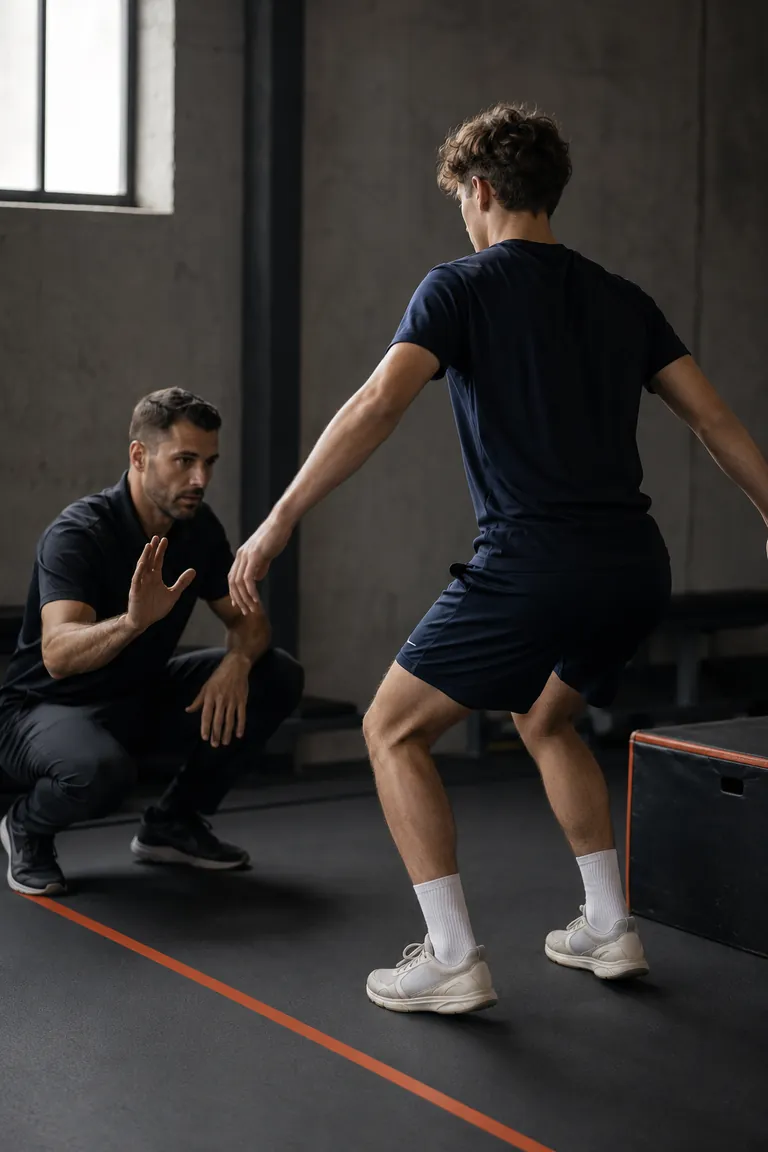
The coach should watch knees on landing. If a knee falls inward, slow the drill down and cue "knees over toes". Our post on ACL injury prevention exercises has more drills.
Strength training is safe and helpful
The 2014 International Consensus statement on youth resistance training says well-supervised strength training is safe and beneficial for children and adolescents. Lauersen and colleagues found that strength training reduces sports injuries in a dose-dependent way across studies of mixed ages. Girls do not become bulky from it. Start with bodyweight, learn technique, then add load slowly under a qualified coach. See can girls lift weights without bulking up.
Load, food and sleep
Overuse injuries such as shin pain, knee pain around the kneecap and heel pain commonly show up in teenage girls during growth spurts and busy seasons. Increase training volume gradually, give a rest day, and avoid playing for school, club and academy in the same week without a break. Eat enough for training and growth. Missed periods, stress fractures or constant tiredness need a doctor.
Common injuries in teenage girls
The injuries seen most often in school and club sport are ankle sprains, knee pain around the kneecap, shin pain and heel pain, plus the ACL tear that gets the most attention. Ankle sprains are common in court sports, and balance training has support: a systematic review and meta-analysis in the International Journal of Sports Physical Therapy found that balance training reduced ankle sprain incidence among athletes. Most of these problems respond to rest, graded loading and a good plan from a physio.
Do not self-diagnose. A girl who limps, cannot jump on one leg, or has swelling needs to be seen.
What a coach or parent can do this month
- Add the 15 minute warm-up above to every practice.
- Film landings from the front once a month.
- Check that footwear is suited to the surface and not worn flat.
- Ask about pain at the start of every session.
- Make sure meals and sleep keep up with training.
These are small habits, yet they match the pieces that research programmes used.
What EvoQuest can do
EvoQuest tests landing and jump asymmetry on force plates and measures strength with dynamometry, then shares simple exercises with athlete and parent. We work with athletes after physio clearance and do not diagnose injuries. See the performance diagnostics page.
If you are a parent or coach wondering what suits your daughter or player, book a free 20-minute call using the call page.
Frequently asked questions
Why are teenage girls more at risk of ACL injury?
After puberty, anatomy, hormones and neuromuscular control combine to raise ACL injury risk in girls compared with boys. Training can improve landing technique, strength and trunk control, which is where programmes aim. No programme removes risk entirely. Understanding this helps parents and coaches focus on what can be trained.
When should injury prevention training start?
Earlier is better. Researchers suggest starting integrative neuromuscular training before or in early puberty so good movement habits form before the rapid changes. For teenagers who are already past that, starting now still helps. Check with a coach who knows the stage of growth.
Is strength training safe for teenage girls?
Yes. The 2014 International Consensus on youth resistance training says supervised programmes are safe and beneficial. Use sound technique, start light and progress slowly. It does not cause bulkiness and it supports injury prevention. Teenagers should also eat well and sleep enough to support the work.
How do I know my daughter is overtrained?
Warning signs include lasting tiredness, falling performance, poor sleep, mood changes, repeated niggles and missed periods. Reduce training and speak to a doctor if these persist. Planned rest weeks and one day fully off each week help prevent overload. Rest weeks planned before they are needed work better than rest after a breakdown.
What should I do if my daughter has knee or shin pain?
Reduce the aggravating activity and see a doctor or physio if it lasts more than a few days, or sooner if there is swelling, a locked knee or night pain. Do not push through. Return to training in stages once cleared. Keep a note of when the pain started so the doctor can follow it.
This article is general education, not medical advice. If you have pain, a recent injury or a medical condition, see a doctor or physiotherapist before training.
References
- Comprehensive warm-up programme to prevent injuries in young female footballers: cluster randomised controlled trial (Soligard et al., 2008) BMJ
- Specific exercise effects of preventive neuromuscular training intervention on ACL injury risk reduction in young females: meta-analysis and subgroup analysis (Sugimoto et al.) British Journal of Sports Medicine
- When to initiate integrative neuromuscular training to reduce sports-related injuries and enhance health in youth? (Myer et al., 2011) Current Sports Medicine Reports
- Dose-response relationship of neuromuscular training for injury prevention in youth athletes: a meta-analysis (Steib et al., 2017) Frontiers in Physiology
- Position statement on youth resistance training: the 2014 International Consensus (Lloyd et al., 2014) British Journal of Sports Medicine
- Anterior cruciate ligament injuries in female athletes: Part 1, mechanisms and risk factors (Hewett, Myer and Ford, 2006) American Journal of Sports Medicine
- The effect of bracing and balance training on ankle sprain incidence among athletes: a systematic review with meta-analysis (Bellows and Wong) International Journal of Sports Physical Therapy
Cibiraj studied Exercise and Sports Science at Deakin University in Australia and worked as a strength and conditioning coach for cricket and football clubs in Melbourne before founding EvoQuest in Coimbatore. He runs the performance assessments and writes every diagnostics report, so the person who measures you is the one who explains the numbers.