
How many push-ups per day
2 to 3 sets of 5 to 10 reps is a sensible start for most beginners. Athletes usually work at 3 to 4 sets of 10 to 20 reps. Quality matters more than the total: stop a set when your form breaks, and add volume slowly over weeks.
 Cibiraj Sathishkumar · Accredited Exercise and Sports Scientist, Founder of EvoQuest
Updated · 3 min read
Key takeaways
- 2 to 3 sets of 5 to 10 reps is a sensible start for most beginners.
- Cue: Plank first
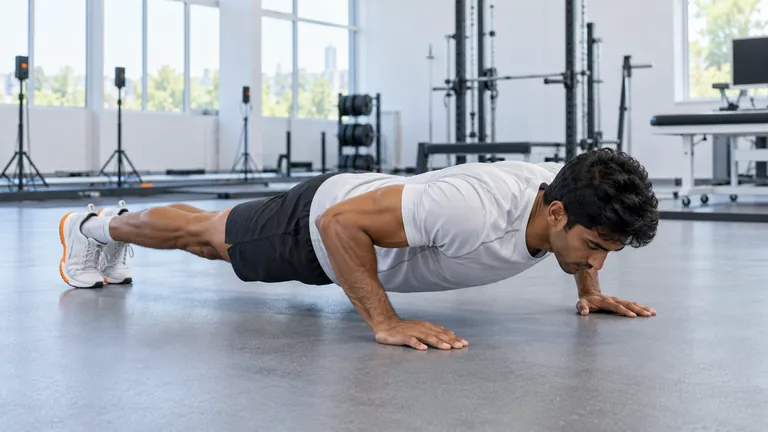
- Cue: Elbows at 45
- Most common mistake: Hips sagging
On this page
How much is enough, by goal
| Goal | Sets, reps or time |
|---|---|
| Beginner | 2 to 3 sets of 5 to 10 reps |
| Athlete | 3 to 4 sets of 10 to 20 reps |
| Strength or power focus | 4 sets of 5 to 8 reps with added weight |
Push-ups can be done two to four times per week. Because they are bodyweight they recover quickly, but watch wrists and shoulders if you add volume fast.
How to build up week by week
| Level | Exercise |
|---|---|
| Easier | Incline push-up on a bench |
| Easier | Knee push-up |
| Easier | Wall push-up |
| Target | push-up |
| Harder | Feet-elevated push-up |
| Harder | Tempo push-up |
| Harder | Weighted push-up |
Move up a level when you can complete all your sets with clean form for two sessions in a row.
A simple 4-week build-up
| Week | What to do |
|---|---|
| 1 | Learn the pattern: Incline push-up on a bench, 2 to 3 sets of 5 to 10 reps |
| 2 | Same exercise, add one rep or a few seconds to each set if every rep was clean |
| 3 | Move to the standard push-up for your first set, keep the easier version for the rest |
| 4 | All sets on the standard push-up; retest your best set and write it down |
Muscles you are training
| Muscle | Role in the push-up |
|---|---|
| pectoralis major | Primary mover |
| triceps | Primary mover |
| anterior deltoid | Primary mover |
| serratus anterior | Assists or stabilises |
| core | Assists or stabilises |
| glutes | Assists or stabilises |
Reps only count with good form
| Mistake | Why it matters | Fix |
|---|---|---|
| Hips sagging | The lower back takes the strain. | Squeeze the glutes and brace the abs. |
| Elbows flared to 90 degrees | This stresses the shoulders. | Point elbows back at about 45 degrees. |
| Half reps | The chest muscles get less work. | Lower until the chest is close to the floor. |
| Head dropping | The neck strains and the spine bends. | Keep the head neutral and eyes down. |
| Hands too far forward | The shoulder takes more load. | Place hands under the shoulders. |
- Plank first
- Elbows at 45
- Chest to the floor
- Push the floor away
Breathe in as you lower and breathe out as you press up.
What extra volume does for sport
- Boxing: Punching strength and shoulder endurance.
- Swimming: Pressing strength and trunk control.
- Kabaddi: Upper-body strength for contact.
- Volleyball: Shoulder stability for overhead work.
Signs you are doing too much
Modify if you have wrist, shoulder or elbow pain. Use handles or fists if wrists hurt. See a physio for ongoing pain.
How EvoQuest measures it
Push-up reps in a timed test, force plate push-ups and a dynamometer test can compare upper-body strength and left-right balance. Motion analysis can check trunk and shoulder position.
In the assessment we film and measure this movement, compare left and right sides, and turn the result into the next block of training.
Frequently asked questions
How many push-ups should I do?
Start with sets you can finish with perfect form. Two to four sets of 5 to 20 reps works for most people. Add reps gradually rather than chasing a big number. If your hips sag or the range shortens, the set is done.
Why do my wrists hurt?
The wrists may be bent too far or the hands too far forward. Place hands under the shoulders, spread the fingers and press through the whole palm. Handles or fists can reduce wrist angle. See a physio if wrist pain keeps returning.
What muscles do push-ups work?
The chest, front of the shoulders, triceps and core. The serratus anterior also works to keep the shoulder blades moving, and the glutes and legs help hold the plank line. It is a simple full upper-body pushing exercise. The upper back and rear shoulder muscles work lightly to keep the shoulder blades steady.
How can I make push-ups harder?
Raise the feet, slow the lowering, add weight or try one-arm progressions. Pausing at the bottom also makes it harder without extra equipment. Change one variable at a time, and keep the plank position clean on every rep. Hands on a medicine ball or rings also add instability and challenge the shoulders more.
This article is general education, not medical advice. If you have pain, a recent injury or a medical condition, see a doctor or physiotherapist before training.
Cibiraj studied Exercise and Sports Science at Deakin University in Australia and worked as a strength and conditioning coach for cricket and football clubs in Melbourne before founding EvoQuest in Coimbatore. He runs the performance assessments and writes every diagnostics report, so the person who measures you is the one who explains the numbers.