
How many hip thrusts per set
2 sets of 10-12 bodyweight or light is a sensible start for most beginners. Athletes usually work at 3 sets of 8-12 with moderate loads. Quality matters more than the total: stop a set when your form breaks, and add volume slowly over weeks.
 Cibiraj Sathishkumar · Accredited Exercise and Sports Scientist, Founder of EvoQuest
Updated · 3 min read
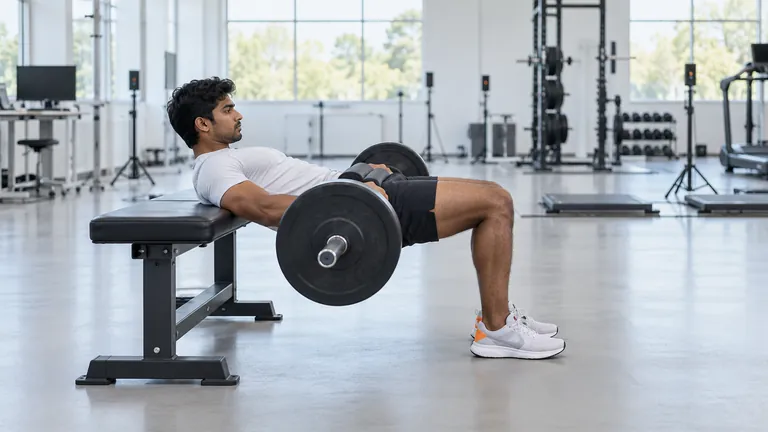
Key takeaways
- 2 sets of 10-12 bodyweight or light is a sensible start for most beginners.
- Cue: Chin tucked
- Cue: Ribs down
- Most common mistake: Over-arching the lower back
On this page
How much is enough, by goal
| Goal | Sets, reps or time |
|---|---|
| Beginner | 2 sets of 10-12 bodyweight or light |
| Athlete | 3 sets of 8-12 with moderate loads |
| Strength or power focus | 3-4 sets of 4-8 heavy |
Hip thrusts can be done 2 times per week. Recovery is modest. Adjust load based on soreness.
How to build up week by week
| Level | Exercise |
|---|---|
| Easier | Glute bridge |
| Easier | Bodyweight hip thrust |
| Easier | Banded hip thrust |
| Target | hip thrust |
| Harder | Barbell hip thrust |
| Harder | Single-leg hip thrust |
| Harder | Hip thrust with a pause |
Move up a level when you can complete all your sets with clean form for two sessions in a row.
A simple 4-week build-up
| Week | What to do |
|---|---|
| 1 | Learn the pattern: Glute bridge, 2 sets of 10-12 bodyweight or light |
| 2 | Same exercise, add one rep or a few seconds to each set if every rep was clean |
| 3 | Move to the standard hip thrust for your first set, keep the easier version for the rest |
| 4 | All sets on the standard hip thrust; retest your best set and write it down |
Muscles you are training
| Muscle | Role in the hip thrust |
|---|---|
| gluteus maximus | Primary mover |
| hamstrings | Assists or stabilises |
| adductors | Assists or stabilises |
| core | Assists or stabilises |
Reps only count with good form
| Mistake | Why it matters | Fix |
|---|---|---|
| Over-arching the lower back | The back moves instead of the hips and the glutes get less work. | Tuck the ribs and chin. |
| Placing the feet too far away | The hamstrings take over the lift. | Move the feet closer so shins are vertical at the top. |
| Placing the feet too close | The quads take over and the knees bend too much. | Move the feet slightly out. |
| Going heavy without a pad | The bar presses on the hip bones and ends the set early. | Use a thick bar pad or a mat. |
| Rushing the reps | Less time under tension in the glutes. | Pause at the top for a second. |
- Chin tucked
- Ribs down
- Shins vertical at the top
- Squeeze hard
Breathe in at the bottom and out as you lift.
What extra volume does for sport
- Sprinting: Hip extension strength drives every stride.
- Football: Kicking and speed both depend on strong glutes.
- Cricket: Bowling power starts in the hips.
- Rugby: Driving in scrums and tackles uses hip extension.
Signs you are doing too much
Stop if you feel pain in the lower back or hips. People with back or hip injuries should check with a doctor or physio.
How EvoQuest measures it
EvoQuest can track bar speed in the hip thrust with velocity-based training and compare left and right hip extension force.
In the assessment we film and measure this movement, compare left and right sides, and turn the result into the next block of training.
Frequently asked questions
What does the hip thrust work?
The glutes mostly, with help from the hamstrings and core. Because the bar sits on the hips and the range ends at full hip extension, it loads the glutes hard where they work most in sprinting.
Hip thrust or squat for glutes?
Both help. The hip thrust loads the glutes at full hip extension, while the squat works them at depth. Many athletes use both because they train different parts of the movement.
How can I stop my lower back from taking over?
Tuck the ribs and chin, set the feet so the shins are vertical at the top, and stop when the torso is level. If you feel the back, lower the weight and slow down.
How heavy should hip thrusts be?
Heavy enough that the last reps are hard, while the form remains clean and the glutes do the lifting. Add weight slowly, and use a thick pad so the bar does not hurt the hips.
This article is general education, not medical advice. If you have pain, a recent injury or a medical condition, see a doctor or physiotherapist before training.
Cibiraj studied Exercise and Sports Science at Deakin University in Australia and worked as a strength and conditioning coach for cricket and football clubs in Melbourne before founding EvoQuest in Coimbatore. He runs the performance assessments and writes every diagnostics report, so the person who measures you is the one who explains the numbers.