
How long to hold a wall sit
2 sets of 20 to 30 seconds is a sensible start for most beginners. Athletes usually work at 3 sets of 30 to 60 seconds. Quality matters more than the total: stop a set when your form breaks, and add volume slowly over weeks.
 Cibiraj Sathishkumar · Accredited Exercise and Sports Scientist, Founder of EvoQuest
Updated · 3 min read
Key takeaways
- 2 sets of 20 to 30 seconds is a sensible start for most beginners.
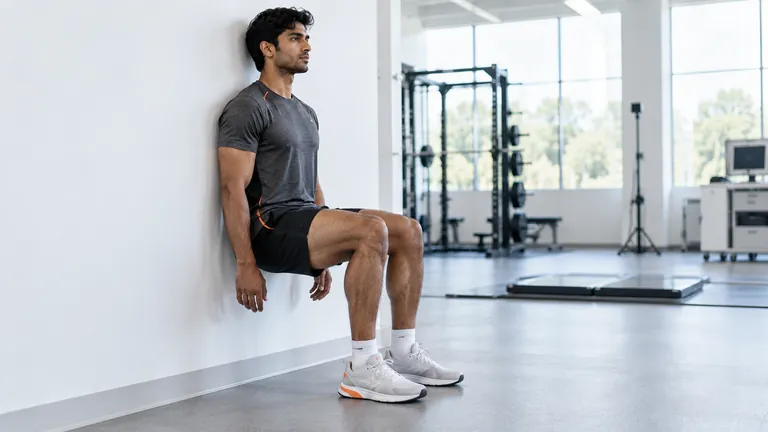
- Cue: Back flat
- Cue: Knees over ankles
- Most common mistake: Knees too far forward
On this page
How much is enough, by goal
| Goal | Sets, reps or time |
|---|---|
| Beginner | 2 sets of 20 to 30 seconds |
| Athlete | 3 sets of 30 to 60 seconds |
| Strength or power focus | 3 sets of 20 to 30 seconds with added load |
Isometrics like the wall sit are low in impact and can be done three to five times a week. Stop if your knees complain.
How to build up week by week
| Level | Exercise |
|---|---|
| Easier | Higher wall sit |
| Easier | Wall squat with shorter hold |
| Easier | Assisted squat hold |
| Target | wall sit |
| Harder | Longer hold |
| Harder | Single-leg wall sit |
| Harder | Wall sit with weight |
Move up a level when you can complete all your sets with clean form for two sessions in a row.
A simple 4-week build-up
| Week | What to do |
|---|---|
| 1 | Learn the pattern: Higher wall sit, 2 sets of 20 to 30 seconds |
| 2 | Same exercise, add one rep or a few seconds to each set if every rep was clean |
| 3 | Move to the standard wall sit for your first set, keep the easier version for the rest |
| 4 | All sets on the standard wall sit; retest your best set and write it down |
Muscles you are training
| Muscle | Role in the wall sit |
|---|---|
| quadriceps | Primary mover |
| glutes | Assists or stabilises |
| calves | Assists or stabilises |
| core | Assists or stabilises |
Reps only count with good form
| Mistake | Why it matters | Fix |
|---|---|---|
| Knees too far forward | Strain on the knees. | Walk the feet out. |
| Resting hands on the thighs | It takes load off the quads. | Keep arms crossed or by the sides. |
| Sliding too low | It loads the knees heavily. | Stop at 90 degrees. |
| Lifting the heels | Load goes to toes. | Keep heels down. |
| Holding the breath | Pressure spikes. | Breathe steadily. |
- Back flat
- Knees over ankles
- Heels heavy
- Breathe steady
Breathe slowly and steadily; do not hold your breath.
What extra volume does for sport
- Skiing and snow sports: Muscle endurance for the tuck position.
- Cricket: Quad endurance for fielding and bowling.
- Football: Leg endurance.
- Badminton: Low stance endurance.
Signs you are doing too much
Stop if you feel knee pain. See a physio for ongoing knee pain.
How EvoQuest measures it
Isometric strength tests on a force plate can show how much force each leg produces. Heart rate response shows effort during holds.
In the assessment we film and measure this movement, compare left and right sides, and turn the result into the next block of training.
Frequently asked questions
What does a wall sit train?
It trains the quads and builds isometric strength endurance. It also teaches you to hold a squat position under fatigue. It does little for the hamstrings and glutes, so use it as one part of a wider leg plan. The wall supports the back, so it is a safe way to load the legs for time.
How long should I hold it?
Twenty to 60 seconds for most people. Hold only as long as form stays good. Rest for equal time between sets. If your knees ache or your back lifts off the wall, stop the set. Beginners can start at 15 to 20 seconds and add 5 seconds each week.
Are wall sits good for knees?
They can build quad strength in a controlled position. Keep the knees over the ankles. Stop if you feel pain at the front of the knee, and see a physio if it persists. A slightly higher position with a shallower knee angle is gentler for sore knees.
Wall sit or squat?
Squats train movement and strength. Wall sits train endurance and are easier to control. Use squats for strength and wall sits for endurance or as a finisher at the end of a session. Do both across a week if you want strength and endurance in the legs.
This article is general education, not medical advice. If you have pain, a recent injury or a medical condition, see a doctor or physiotherapist before training.
Cibiraj studied Exercise and Sports Science at Deakin University in Australia and worked as a strength and conditioning coach for cricket and football clubs in Melbourne before founding EvoQuest in Coimbatore. He runs the performance assessments and writes every diagnostics report, so the person who measures you is the one who explains the numbers.