
How does motion capture work: markers, calibration, inverse kinematics and error
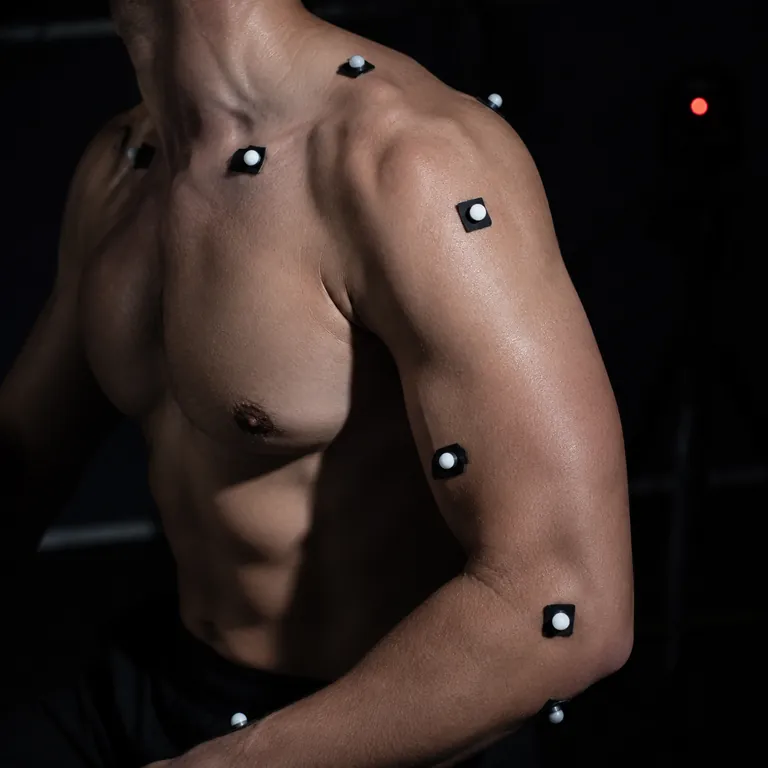
Optical motion capture uses infrared cameras to track reflective markers fixed to the skin. Each camera sees a marker as a bright dot, and software triangulates the dots from several cameras into 3D positions, typically 100 to 250 times a second. A body model then turns marker paths into joint angles.
 Cibiraj Sathishkumar · Accredited Exercise and Sports Scientist, Founder of EvoQuest
Updated · 4 min read
Key takeaways
- Cameras flash infrared light and see reflective markers as bright dots; calibration with a wand sets camera positions.
- Triangulation from at least two cameras gives each marker's 3D position, and more cameras reduce gaps.
- Inverse kinematics fits a skeleton to the markers to give joint angles.
- Soft-tissue artefact, marker placement and occlusion are the main errors.
- Adding force plates lets software estimate joint forces and moments.
On this page
Cameras that see only markers
Each camera in an optical system carries a ring of infrared LEDs that flash in time with the shutter. Reflective markers, small balls coated to bounce light straight back, show up as very bright dots against a dark background. The camera does not need to recognise a person, only to find bright circles, and the software finds the centre of each dot to a fraction of a pixel. The plain-language introduction is in what is motion capture.
Before use the system is calibrated in two steps. First, the capture volume is set up by waving a wand with markers at known distances apart through the space, which tells the software where every camera is and how its lens bends the picture. Second, the origin and axes are set by placing an L-shaped frame on the floor, often aligned with a force plate. Calibration quality is reported as a residual error, usually a fraction of a millimetre, and good labs recalibrate before each session.
From dots to 3D positions
When two calibrated cameras see the same marker, each defines a line from the camera into the room. The marker sits where the two lines cross, and in practice the software takes the point closest to both lines. Adding cameras improves accuracy, and importantly keeps a marker visible when the athlete's arm or another body part blocks the view from one camera. A marker seen by fewer than two cameras is lost for that frame.
Software then labels each dot (which one is the left knee?) and fills short gaps by interpolating from neighbouring frames. Raw marker paths contain noise, so they are smoothed by a low-pass filter. The cut-off must suit the movement: too low and real peaks are flattened, too high and noise is left in. Noise matters more when you compute velocities and accelerations, because differentiating a signal amplifies its noise.
From markers to joint angles
A marker is a point on the skin, and a coach wants an angle at the knee. The bridge is a biomechanical model. Markers placed on bony landmarks, such as the hip bone, the knee sides and the ankle bones, define segments (pelvis, thigh, shank, foot). Joint centres are estimated from the landmarks. The angle between the thigh and shank segments in 3D gives knee flexion.
Inverse kinematics fits the skeleton to the marker paths in every frame by choosing the joint angles that best explain where the markers are. If force plates are in the room, inverse dynamics goes one step further. It uses the ground force, the segment masses and accelerations to compute the net moments at each joint, which is how labs study knee loading in landings and cuts. See how force plates work for the force side.
Sources of error
Optical capture is precise for the markers, but the markers are not the bones. Skin slides over bone during movement, a problem called soft-tissue artefact, and it is largest around the thigh and shoulder where there is more soft tissue. Different testers may place markers a centimetre apart from session to session, which changes the angle estimate even if the athlete moves identically. The model's joint centre estimates carry assumptions as well.
Frame rate sets the limit on fast events. A system at 100 frames per second gives a frame every 10 ms. Sunlight contains infrared and can create false dots, so outdoor use is harder.
For wearable alternatives, a systematic review and meta-analysis on inertial units (IMUs) in healthy adults found that they reliably measure spatiotemporal gait parameters during running, but lower-limb joint kinematics should be reported with caution. Colyer and colleagues' review of vision-based analysis in Sports Medicine - Open traces how camera methods evolved and why markerless approaches need scrutiny. The newer approach is covered in how markerless motion capture works.
Reading motion capture sensibly
Look at patterns across several repetitions, not a single trial. Keep the marker set, the tester and the movement identical across sessions. Treat differences of a few degrees with caution, since marker placement alone can create them. Use motion capture to see how an athlete moves, then pair it with strength and jump data to decide what to do about it. Compare approaches in markerless versus marker-based motion capture and read the broader picture in motion capture in sports performance.
EvoQuest's three-hour assessment in Ramanathapuram, Coimbatore, includes motion analysis alongside force plates and other measures. The athlete's view is in motion capture for athletes.
If you want to know whether a test like this suits your sport or your child, start with a free 20-minute call on the call page or WhatsApp +91 93440 48834.
Frequently asked questions
How does motion capture work?
Infrared cameras flash light that reflective markers on the skin bounce straight back, so each marker appears as a bright dot. Software triangulates the dots from several calibrated cameras into 3D paths, then fits a body model to compute joint angles.
How many cameras does motion capture need?
At least two cameras must see a marker to place it in 3D. Labs use many more, often eight or more, so that arms, the other leg or equipment do not block a marker from all views. More cameras means fewer gaps.
What is soft-tissue artefact?
Markers sit on the skin, and skin moves over the bone beneath it. The marker therefore moves slightly differently from the bone it represents. This adds error, especially around the thigh and shoulder, and it is one of the main limits of marker-based systems.
What is inverse kinematics?
Inverse kinematics finds the joint angles that best explain where the markers are in every frame. The model has fixed segment lengths and joint types, so the software searches for the pose that fits the marker paths with the least error.
Can motion capture measure joint forces?
Yes, when combined with force plates. Inverse dynamics uses the ground force, the segment masses and the motion to estimate the net moments at each joint. These are estimates that depend on the model and on marker quality.
This article is general education. Train within your current ability and get coaching if you are unsure about technique.
References
- A review of the evolution of vision-based motion analysis and the integration of advanced computer vision methods towards developing a markerless system (Colyer et al., 2018) Sports Medicine Open (PMC)
- Validity and reliability of inertial measurement units on lower extremity kinematics during running: a systematic review and meta-analysis Sports Medicine - Open
Cibiraj studied Exercise and Sports Science at Deakin University in Australia and worked as a strength and conditioning coach for cricket and football clubs in Melbourne before founding EvoQuest in Coimbatore. He runs the performance assessments and writes every diagnostics report, so the person who measures you is the one who explains the numbers.