
Hip mobility exercises: Athlete Guide
Hip mobility improves fastest with a few well-chosen drills done often and done well. Start with the simpler drills below, keep each set short and high quality, and test yourself every few weeks so you know the work is paying off.
 Cibiraj Sathishkumar · Accredited Exercise and Sports Scientist, Founder of EvoQuest
Updated · 3 min read
Key takeaways
- Hip mobility improves fastest with a few well-chosen drills done often and done well.
- Cue: Sit tall
- Cue: Move slow
- Most common mistake: Forcing the knees down
On this page
Hip mobility drills
- 90/90 transitions: Sit in a 90/90 and rotate both knees to the other side without using your hands.
- Hip CARs: On hands and knees, draw the largest slow circle you can with one knee.
- Frog stretch: Kneel with knees wide and rock back gently.
- Deep squat hold: Hold the bottom of a squat with a support.
- World's greatest stretch: Lunge, put the hand inside the foot, and rotate the chest open.
- Cossack squat: Shift side to side in a wide stance.
What good technique looks like
- Sit tall
- Move slow
- Press the knee down
- Breathe
How to test it
Seated hip rotation test: Sit on a bench with knees bent at 90 degrees, rotate the shin out and then in while keeping the thigh still, and measure the angle each way with a phone or goniometer.
Compare left to right and track your own change; differences of more than about 10 degrees between sides are worth a closer look.
Technique, step by step
- 1
Step 1
Sit in a 90/90 position with both knees bent at 90 degrees.
- 2
Step 2
Rotate the knees to the other side, keeping the torso tall.
- 3
Step 3
Lean forward over the front shin and hold gently.
- 4
Step 4
Lift the back knee off the floor to train control.
- 5
Step 5
Switch sides slowly.
- 6
Step 6
Finish with a deep squat hold.
Common mistakes
| Mistake | Why it matters | Fix |
|---|---|---|
| Forcing the knees down | It can strain the knee instead of improving the hip. | Move within a comfortable range. |
| Rounding the lower back to sit | The hip does not move, so the back does the work. | Sit on a pad and keep the chest tall. |
| Rushing through positions | Control is lost and the joint is not trained through range. | Move through each position over 2 to 3 seconds. |
| Ignoring pinching in the hip | Pinching can mean a joint issue. | Stop and ask a doctor or physio. |
| Only stretching, no strength | New range is unstable if it is never trained actively. | Add active holds, lunges and squats. |
How much and how often
| Goal | Sets, reps or time |
|---|---|
| Beginner | 1 to 2 rounds of 6 slow reps per side |
| Athlete | 2 to 3 rounds daily as part of a warm-up |
| Strength or power focus | Add active strength work through the range |
Mobility responds to frequent practice. A few minutes daily is usually better than one long weekly session.
Where it shows up in sport
- Badminton: Lunging and turning on court need free hip range.
- Cricket: Bowling and batting rotate the hips at speed.
- Kabaddi: Wide stances and quick turns depend on mobile hips.
- Football: Kicking and cutting use hip rotation and extension.
Safety
Stop if you feel pinching in the front of the hip or groin pain. People with hip injuries should check with a doctor or physio.
How EvoQuest measures it
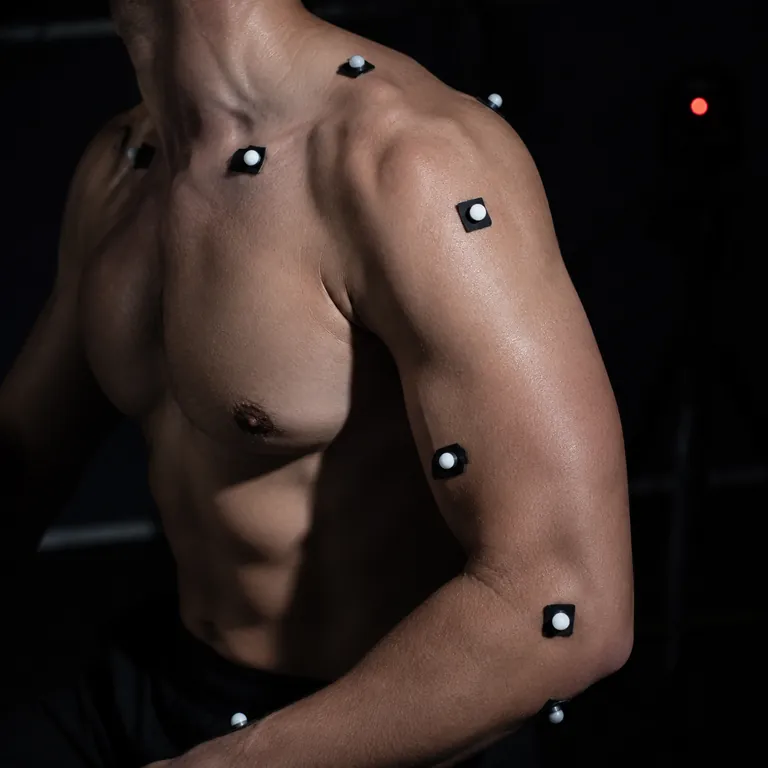
EvoQuest can measure hip internal and external rotation range with motion analysis and compare left and right.
In the assessment we film and measure this movement, compare left and right sides, and turn the result into the next block of training.
Frequently asked questions
What is hip mobility?
It is how freely the hip joint moves in all directions, including bending, rotation and spreading the legs. Good mobility helps squatting, running and changing direction without the lower back or knees compensating.
How do I improve hip mobility?
Practise slow controlled movements like 90/90 transitions and hip circles, and add strength work to hold the new range, such as lunges and Cossack squats. Do it most days for a few minutes.
What are 90/90 hip stretches?
The 90/90 is a seated position with both knees bent at 90 degrees and the legs in different rotations. Moving between sides trains internal and external rotation of the hip.
Why does my hip pinch in a squat?
Common reasons include joint shape, tight muscles or poor control. A pinch at the front of the hip that repeats should be looked at by a doctor or physio rather than stretched harder.
This article is general education, not medical advice. If you have pain, a recent injury or a medical condition, see a doctor or physiotherapist before training.
Cibiraj studied Exercise and Sports Science at Deakin University in Australia and worked as a strength and conditioning coach for cricket and football clubs in Melbourne before founding EvoQuest in Coimbatore. He runs the performance assessments and writes every diagnostics report, so the person who measures you is the one who explains the numbers.