
Functional movement screen explained: what it tests and what it cannot tell you
The functional movement screen (FMS) is a set of seven movement tests, each scored 0 to 3, giving a total out of 21. It looks for limits and left-right differences in basic movement. Reviews found it does not reliably predict injury on its own, so use it as a conversation starter.
 Cibiraj Sathishkumar · Accredited Exercise and Sports Scientist, Founder of EvoQuest
Updated · 4 min read
Key takeaways
- The FMS has seven movement tests, scored 0 to 3 each, for a maximum of 21.
- It highlights movement limits and left-right differences.
- A 2017 review found the composite score does not support injury prediction.
- Scoring depends on the tester, so use trained raters.
- If something hurts, stop and see a doctor or physio.
On this page
What the FMS measures
The functional movement screen asks an athlete to do seven basic movements and scores the quality of each. It checks mobility, stability and control. It does not measure strength, speed or fitness.
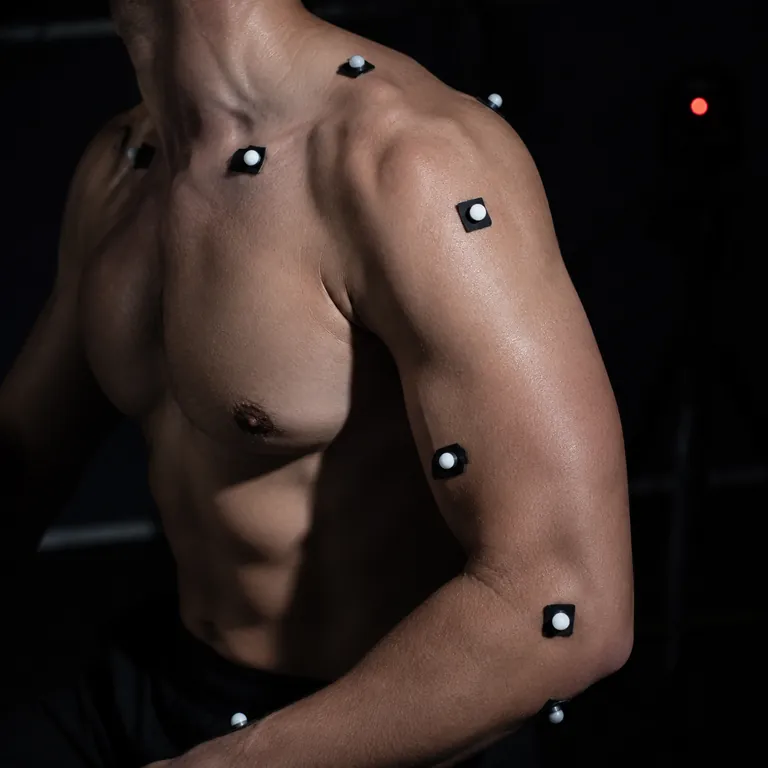
The tests are the deep squat, hurdle step, in-line lunge, shoulder mobility, active straight-leg raise, trunk stability push-up and rotary stability. Three clearing tests check for pain. The idea is to find movement problems that deserve a closer look. Our post on motion capture covers a more detailed alternative.
How the scoring works
Five tests are done on each side, and the lower score counts. The seven scores add to a composite out of 21. Asymmetry between left and right is often more useful than the total, because it points to a specific side.
- 1
Explain and demonstrate
Show each of the seven movements and explain what you will score.
- 2
Run the movements
Let the athlete attempt each pattern up to three times, and score the best.
- 3
Check both sides
Test left and right where relevant and keep the lower score.
- 4
Stop at pain
Score 0 and refer any painful movement to a doctor or physio.
- 5
Add up and record
Total the seven scores out of 21 and note any left-right differences.
The protocol
- Explain the test and demonstrate each movement.
- Let the athlete try each movement up to three times and score the best.
- Run the clearing tests for shoulder, trunk and hip pain.
- Record both sides and the total.
- Stop at any test that causes pain, score it 0, and refer the athlete to a doctor or physio.
No warm-up beyond easy movement is needed, but keep the same order and instructions every time. Scores shift if the tester coaches the movement differently.
Does it predict injury?
Moran and colleagues reviewed 24 studies in the British Journal of Sports Medicine in 2017. They concluded that the composite score does not support its use as an injury prediction tool and found moderate evidence against its use for predicting injury in football. In male military personnel the link was statistically significant but small.
A 2018 review in BMJ Open Sport and Exercise Medicine reported that the unclear link remains, with a lot of variation between studies. The practical message is that a low score does not tell you an athlete will be hurt, and a high score does not protect them.
How reliable is the scoring?
Scores depend on the person watching. Trained raters agree more often than untrained ones, but the 0 to 3 scale is coarse, and small differences in a movement can change the score. A narrower scale makes it easy for two testers to see different things.
Compare athletes only when the same rater uses the same instructions. If scores change between testers, treat that as measurement noise.
Using the FMS sensibly
Use the screen to notice, then dig deeper. A sharp left-right difference in a lunge or a limited squat can prompt a closer look at ankle mobility, hip control or technique. Our athlete assessment guide shows how screens fit with strength, jump and speed data.
Do not rank athletes by total score or drop players from a team because of it. Pair the screen with strength tests, sport history and a conversation about past injuries.
What to do with a score of 1 or an asymmetry
Coaches usually look at the individual patterns before the total. A 1 on a single pattern, or a clear difference between left and right, is more useful than a total of 15 or 16. It points to a place to look more closely, such as ankle range on the deep squat, hip stability on the lunge, or shoulder range.
A pain response is scored 0 and is a reason to refer to a physio or doctor, not to train through it. The clearing tests for the shoulder, spine extension and spine flexion are there to catch pain that the scored patterns could miss.
Pairing the screen with other tests
The FMS describes quality of movement in simple patterns. It does not measure strength, speed or power. Pairing it with a jump test, a hop test or a strength test gives a fuller picture. In a squad, a screen at the start of pre-season can flag who needs a closer look, and a retest after a block shows whether movement has changed.
Score the same way each time, with the same trained tester, because scoring a 2 or a 3 involves judgement. Share the video with the athlete so they can see what the tester saw.
Movement screening at EvoQuest
EvoQuest in Ramanathapuram, Coimbatore, uses force plates and motion analysis in the lab assessment to look at how an athlete moves and loads each leg. See the performance diagnostics page for the set of measures.
For questions about screening your athlete, book a free 20-minute call on the call page.
Frequently asked questions
What is the functional movement screen?
It is a set of seven basic movement tests scored 0 to 3 each, giving a total out of 21. It looks at mobility, stability and control to flag limits or left-right differences that a coach may want to investigate further.
What is a good FMS score?
A total of 14 or below is often used as a flag, but reviews show this cut-off does not reliably predict injury. A score is most useful when it points to a specific limit, not as a verdict on the athlete.
Can the FMS predict injury?
Not reliably. A 2017 review of 24 studies found that the composite score does not support injury prediction. Some groups showed a small association, but findings varied widely between studies.
Who should do the FMS?
Healthy athletes without current pain, with a trained tester. Anyone with pain or a recent injury should see a doctor or physio first. The screen stops at any painful movement.
How is the FMS different from motion capture?
The FMS is a quick scored checklist done by eye. Motion capture measures joint angles and movement in detail using cameras or sensors. The screen is cheaper but coarser and depends more on the tester.
Should children do the FMS?
It can be used with adolescents, but scores change with growth and motor skill, so interpret them as a development snapshot and not a ranking.
How long does the FMS take?
About 10 to 15 minutes for the seven patterns and three clearing tests when run by a trained tester.
This article is general education. Train within your current ability and get coaching if you are unsure about technique.
References
- Do Functional Movement Screen (FMS) composite scores predict subsequent injury? A systematic review with meta-analysis (Moran et al., 2017) British Journal of Sports Medicine
- Is a low Functional Movement Screen score (14/21 or less) associated with injuries in sport? A systematic review and meta-analysis BMJ Open Sport & Exercise Medicine
Cibiraj studied Exercise and Sports Science at Deakin University in Australia and worked as a strength and conditioning coach for cricket and football clubs in Melbourne before founding EvoQuest in Coimbatore. He runs the performance assessments and writes every diagnostics report, so the person who measures you is the one who explains the numbers.