
Football fitness training for 17 year olds: build power, manage exam load
A 17 year old footballer can usually train like a junior adult: heavier strength work, power and jump training, repeated sprint conditioning and structured recovery. The Class 12 board year adds mental and time pressure, so the plan should be efficient, reduce junk volume and protect sleep. Technique and individual testing still guide progress.
 Cibiraj Sathishkumar · Accredited Exercise and Sports Scientist, Founder of EvoQuest
Updated · 4 min read
Key takeaways
- At 17 most players tolerate heavier strength and power work with good coaching.
- Repeated sprint ability matters more than steady running for match fitness.
- Board-exam year means short, efficient sessions and firm sleep habits.
- Trials and selection games create sudden spikes in load that need planning.
- Individual testing can show which physical quality is limiting the player.
On this page
What is different at 17
Sixteen is about building the strength base. At 17 the player usually has one more year of training age, so the question becomes how to turn that strength into speed and repeated high-intensity actions. Bone and tendon capacity are still improving, and boys often keep adding muscle for several years, so patient progression pays off.
The Class 12 board year is the other big difference. Many families expect football to be paused, but the evidence on physical activity from the WHO suggests regular activity is helpful for health and learning. The better plan is a smaller, sharper programme rather than none.
Strength and power at 17
The base lifts stay the same, but the aim shifts. Use 3 to 5 sets of 3 to 6 repetitions on the main lift for strength, with long rests, and follow it with jumps or medicine-ball throws for power. A review of training principles for power explains that heavy strength and fast movement are both needed, because force alone does not guarantee speed.
Plyometrics can progress from landings and box jumps to bounding and single-leg hops, as long as landing quality is clean. Keep jump contacts low in the first weeks and reduce them on match days.
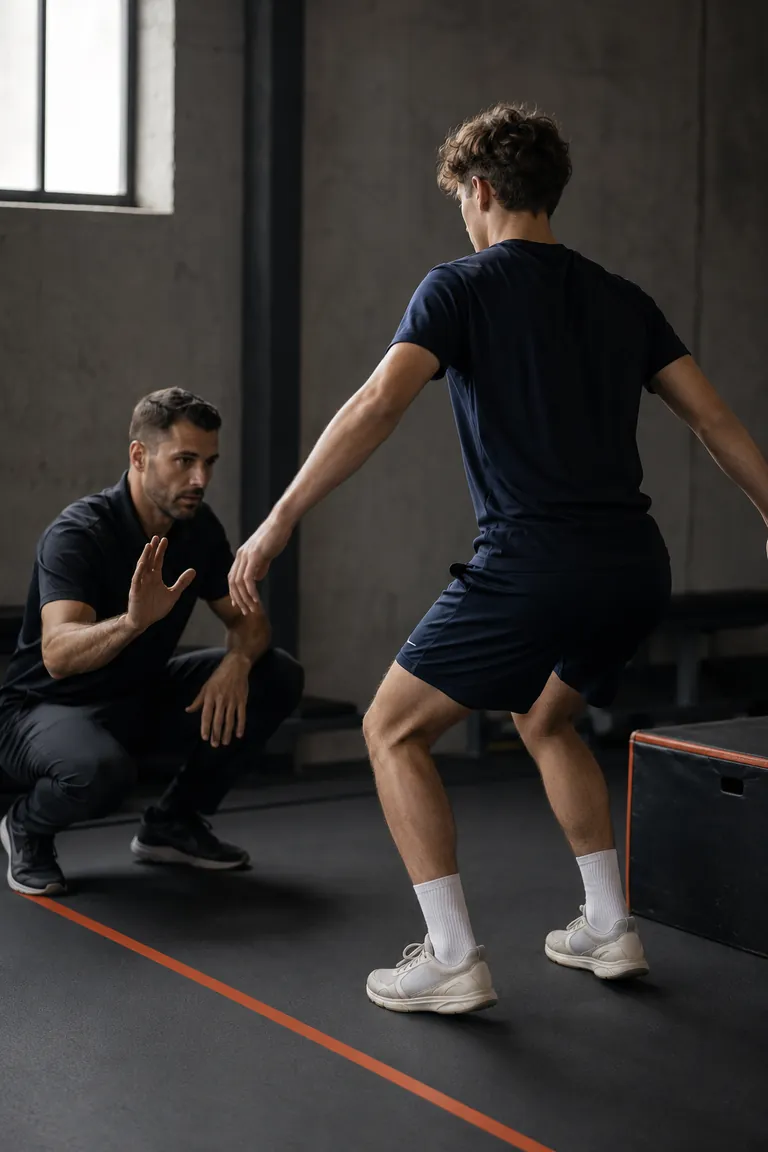
Jump training also helps the landing side of the equation. A player who can absorb force on one leg, hold the position and then push out of it has a better chance of staying fit through a long season. Film single-leg landings from the front and check that the knee stays over the foot instead of dropping inward.
Repeated sprint ability and match fitness
A football match is a sequence of short sprints separated by jogging and walking. Training for that means repeating efforts of 5 to 8 seconds with 20 to 40 seconds of recovery, in sets of 4 to 6 efforts, rather than running 5 km. Small-sided games of 4 v 4 or 5 v 5 with large pitch size reach similar intensity while keeping the ball involved.
The Yo-Yo intermittent recovery test is widely used to monitor this quality in football, and a systematic review reports good test-retest reliability. Tests like this are better for tracking one player over months than ranking players against each other.
A practical approach is to run a short repeated sprint set once every two to three weeks and record the best and slowest time. If the gap between them widens while strength work is going well, the player may need more recovery or more aerobic base. If the gap shrinks, conditioning is working and volume can stay the same.
Selection, trials and tendon care
At 17, trials, district teams and academy cut-offs create sudden bursts of matches in a short period. Gabbett's work on training load argues that well-prepared athletes handle high loads better, while sudden spikes are risky, so the base in the months before a trial counts more than a last-minute push.
Agree on the plan with the coach before selection week. Know which day is a rest day, how long you will play in each trial game, and who to tell if something hurts. A quiet conversation beforehand prevents the situation where a niggle is hidden for fear of losing a place and becomes a month-long injury.
Knee pain at the front of the joint or heel pain are common signals of tendon overload in adolescents who have increased jumping or running rapidly. Reduce volume, keep moving without pain, and see a doctor or physiotherapist if it persists.
Sample week for a board-exam year
- Two strength sessions of 40 to 50 minutes, each ending with power work
- Two football practices, one with repeated sprint games
- One match or trial game
- One light day of mobility, easy cycling or walking
- One full rest day, with the last hour before sleep free of screens and revision
In exam weeks drop to one strength session and one football practice. This is general guidance and not an EvoQuest programme.
What the lab can measure for a 17 year old
EvoQuest can test jump height and rate of force development on force plates, 10 and 30 metre sprint times, barbell speed using velocity-based tools, and GPS-based match load. These numbers show which quality to train next. Book a free 20-minute call if you would like to talk through whether an assessment suits your child's schedule.
Frequently asked questions
Is 17 too late to get fit for football trials?
No, but build gradually. Eight to twelve weeks of structured strength, sprint and conditioning work can improve readiness. Avoid cramming a month before trials with extra sessions, since sudden load spikes are linked to injury. Sleep and nutrition support the gains.
Can I train for football during board exams?
Yes, with fewer sessions. A short weekly routine of one strength session, one practice and easy walking keeps fitness and helps stress. Cut volume further in the final exam week and keep a regular sleep time. Physical activity supports concentration.
How heavy should a 17 year old lift?
Most players can use moderate to heavy loads in the 3 to 6 repetition range once technique is solid and a coach is supervising. Add weight in small steps and stop each set with reserve. Maximal single attempts are optional and rarely necessary.
How can I test my football fitness at 17?
Common field options are a 30 metre sprint, a countermovement or standing jump, and the Yo-Yo intermittent recovery test. Compare yourself with your own earlier results rather than with others, and test on rested days with the same surface and footwear.
This article is general education. Train within your current ability and get coaching if you are unsure about technique.
References
- National Strength and Conditioning Association position statement on long-term athletic development (Lloyd et al., 2016) Journal of Strength and Conditioning Research
- World Health Organization 2020 guidelines on physical activity and sedentary behaviour British Journal of Sports Medicine
- Training principles for power (Haff and Nimphius, 2012) Strength and Conditioning Journal
- Test-retest reliability of the Yo-Yo test: a systematic review Sports Medicine, 2019 (Grgic and colleagues)
- The training-injury prevention paradox: should athletes be training smarter and harder? British Journal of Sports Medicine, Gabbett, 2016
- How much is too much? (Part 1) International Olympic Committee consensus statement on load in sport and risk of injury British Journal of Sports Medicine, 2016
Cibiraj studied Exercise and Sports Science at Deakin University in Australia and worked as a strength and conditioning coach for cricket and football clubs in Melbourne before founding EvoQuest in Coimbatore. He runs the performance assessments and writes every diagnostics report, so the person who measures you is the one who explains the numbers.