
Badminton fitness training for 10 year olds: learn the lunge, land softly
At 10, most children are still before their growth spurt and learn movement patterns quickly. Badminton fitness can add lunge and landing technique, balance, light core work and quick-reaction games. Use bodyweight and coaching cues, keep sessions short, and rotate sports so the racket arm and knees get recovery.
 Cibiraj Sathishkumar · Accredited Exercise and Sports Scientist, Founder of EvoQuest
Updated · 4 min read
Key takeaways
- Ten is a strong window for learning lunge, split-step and landing technique.
- Balance and trunk control support the overhead stroke and reduce wobble in lunges.
- Bodyweight exercises with clear coaching cues are enough.
- Reaction games build shuttle-reading and first-step quickness without heavy load.
- Plan school exams and holidays around practice instead of adding more.
On this page
What changes between 9 and 10
The main change from 9 is attention and coordination. A 10 year old can usually hold a technique cue for a few repetitions, so lunge and landing mechanics can now be taught directly instead of only through play. Most children are still pre-PHV, which keeps the plan gentle, but the coach can start to name the movements: split step, lunge, recover.
Compared with the previous year, add more structure to the warm-up and begin to count repetitions. Do not add load.
The lunge and the recovery step
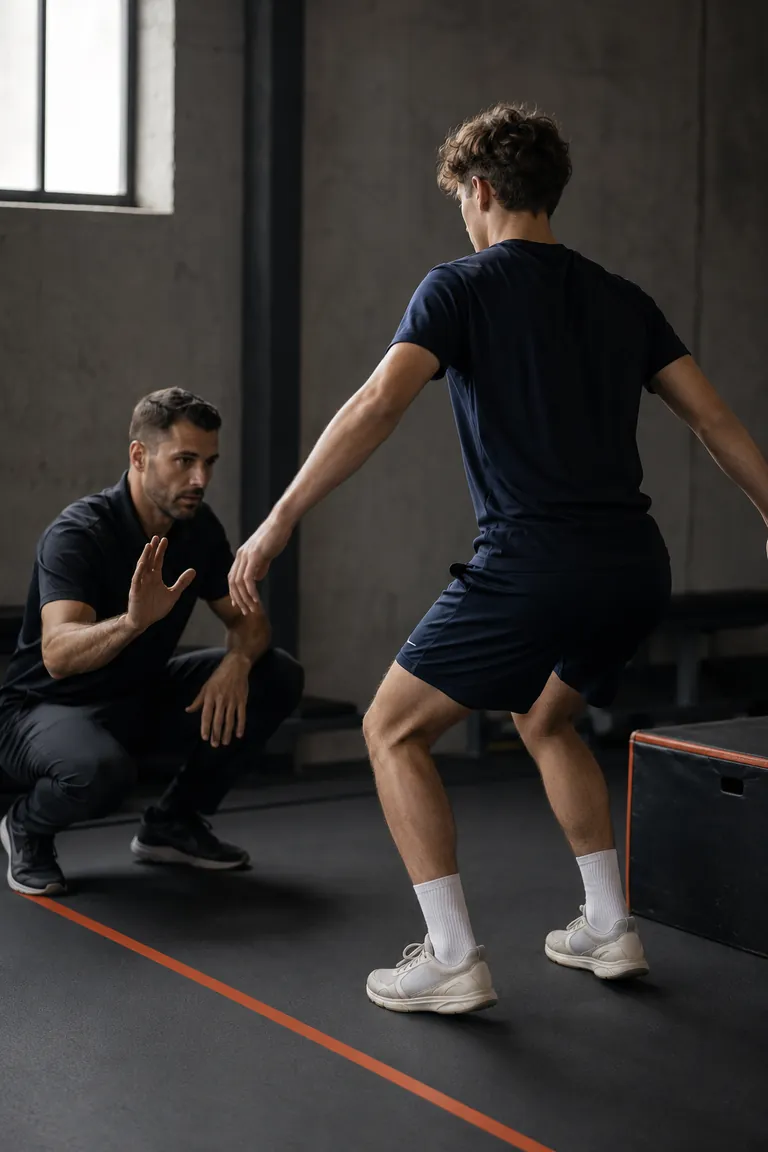
Badminton players lunge for most shots to the front court. A good lunge for a 10 year old has the knee tracking over the foot, the chest upright and a push back to the centre. Teach it in three stages.
- Static split stance, hold for five seconds, balance without wobbling.
- Slow step-out and step-back lunge, two sets of 5 to 8 per leg.
- Lunge to a target on the floor, then push back to centre as the coach calls a corner.
If the knee falls inward, go back to the previous stage. The badminton injury prevention guide has more on knee and ankle care.
Landing and jumping basics
Overhead shots and jump smashes lead to landings, and soft landings are a skill. Teach hop-and-stick: jump, land on both feet, bend the hips and knees, hold for two seconds. Progress to single-leg landings only when the double-leg version looks steady. Two sets of 5 jumps is plenty.
Balance work on a line or a folded mat, with eyes on a shuttle thrown by a partner, joins the footwork and the hands together. Reaction games, such as reacting to a coloured card or a coach pointing a direction, train the first step in a way that feels like play.
Sample week for a 10 year old
A generic example, shaped around a school week.
Keep rest days real. A child who is active every day without a break is more likely to complain of heel, knee or elbow soreness.
Keep the racket arm safe
Reviews of youth badminton injuries describe the shoulder, elbow, knee and ankle as common problem sites, and note that many cases relate to repeated play without enough recovery. For a 10 year old, limit hard overhead practice, mix forehand and backhand work, and use soft shuttles for long rallies. If a child complains of arm or heel pain more than once, rest and ask a doctor or physio, rather than pushing through.
Exams, holidays and heat
Class 5 is not a heavy exam year, but unit tests and school activities still crowd the calendar. Use the long summer break for variety: swimming camps, cycling and a few court sessions instead of daily double batches. In humid Tamil Nadu weather, drink water before, during and after sessions, and keep indoor halls ventilated with a fan or open doors where possible.
A simple checklist for parents and coaches
Before adding anything to a 10 year old's week, run through a short list.
- Can the child lunge to each corner without the knee collapsing inward?
- Do landings look quiet, with hips and knees bending?
- Is there at least one full rest day, and does the child sleep well?
- Does the child play another sport or free-play outdoors?
- Is any soreness in the heel, knee or elbow lasting more than a few days?
If the answers are mostly yes, the plan is balanced. If not, fix technique and rest before adding more badminton. Children develop at different speeds, so compare a child with their own earlier videos rather than with a teammate.
What EvoQuest can add at 10
For a 10 year old, EvoQuest can look at lunge control, single-leg balance and landing quality using movement observation, and explain what the findings mean in plain language for parent and coach. The aim is to catch awkward patterns early and shape play-based drills, not to rank children by numbers.
Start with a free 20-minute call using the call page.
Frequently asked questions
What exercises are good for a 10 year old badminton player?
Staged lunges, hop-and-stick landings, single-leg balance, light core work like bird dog, and short reaction games. Use bodyweight and a coach watching form. A few clean sets matter more than many sloppy ones.
Is a 10 year old too young for core exercises?
No. Gentle trunk work such as dead bug, bird dog and short planks is fine when technique is controlled. Keep holds brief and stop when form slips. Playful versions work well at this age.
Should a 10 year old specialise in badminton only?
Youth development guidance advises against early specialisation for most children. Playing other sports builds broader movement skill and spreads load across the body. Badminton can be the main sport while still leaving room for others.
How do I stop my 10 year old getting knee or heel pain?
Teach good lunge and landing form, avoid a sudden jump in playing time, and keep rest days. If pain lasts more than a few days or changes how the child moves, see a doctor or physio for advice.
Can 10 year olds use resistance bands?
Light bands for shoulder or hip activation are acceptable when supervised and when the child can control the movement. Keep reps modest and avoid straining. They are an optional extra rather than a requirement.
This article is general education. Train within your current ability and get coaching if you are unsure about technique.
References
- National Strength and Conditioning Association position statement on long-term athletic development (Lloyd et al., 2016) Journal of Strength and Conditioning Research
- Position statement on youth resistance training: the 2014 International Consensus (Lloyd et al.) British Journal of Sports Medicine
- When to initiate integrative neuromuscular training to reduce sports-related injuries and enhance health in youth? Current Sports Medicine Reports (Myer et al., 2011)
- Injury epidemiology, patterns, and risk factors in youth and adolescent badminton players: a scoping review (Dhawale et al., 2026) Frontiers in Sports and Active Living
Cibiraj studied Exercise and Sports Science at Deakin University in Australia and worked as a strength and conditioning coach for cricket and football clubs in Melbourne before founding EvoQuest in Coimbatore. He runs the performance assessments and writes every diagnostics report, so the person who measures you is the one who explains the numbers.